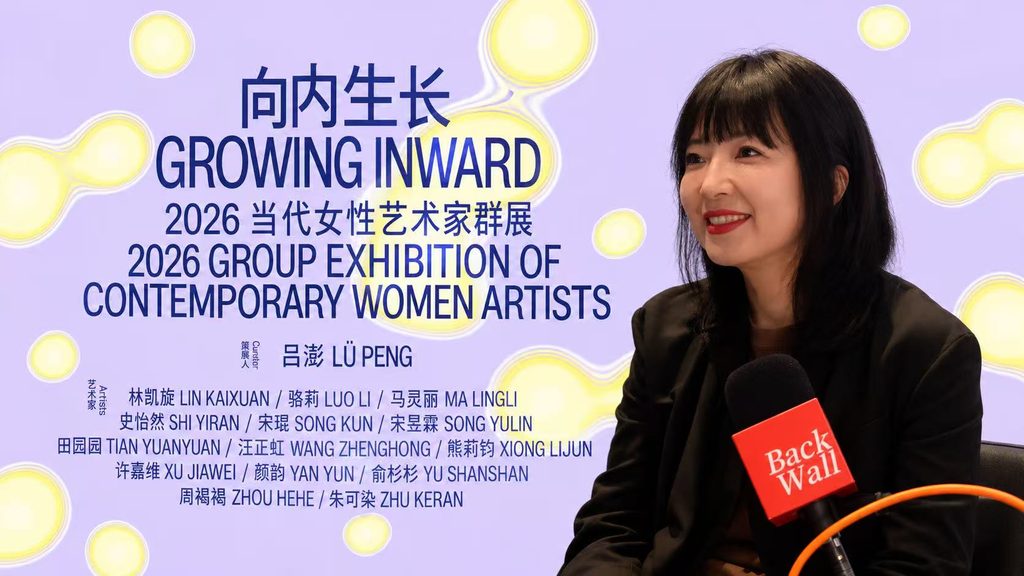
From October 10 to November 22, 2026, Growing Inward, a group exhibition of contemporary women artists curated by Lu Peng, is on view at the Chengdu Art Museum, Gallery B2, Building B.
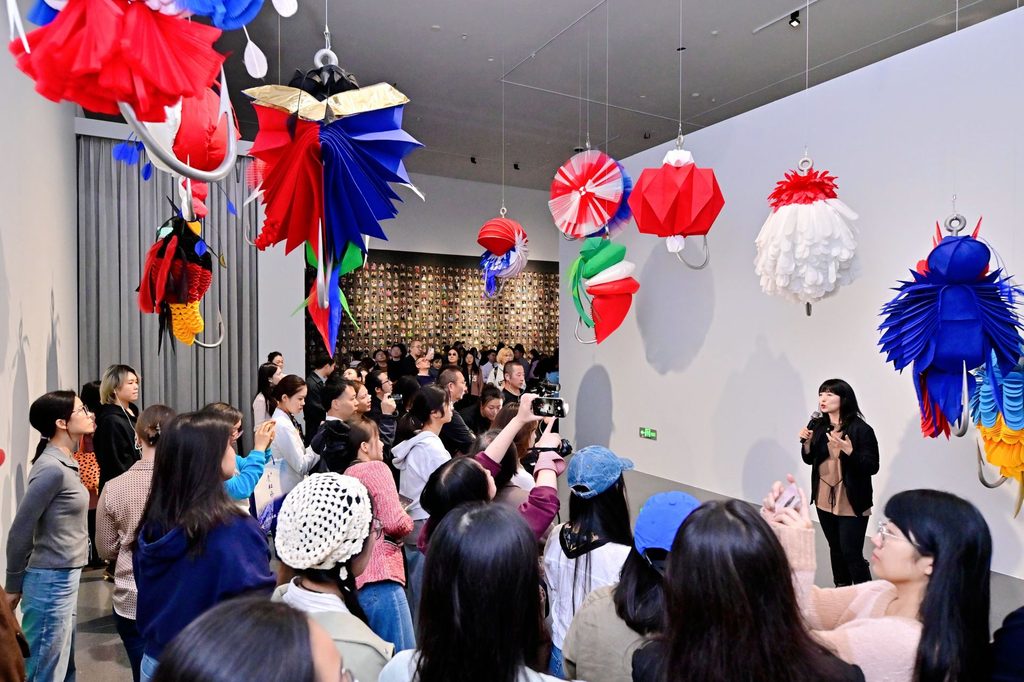
On October 10, BACKWALL spoke with participating artist Luo Li at the exhibition.
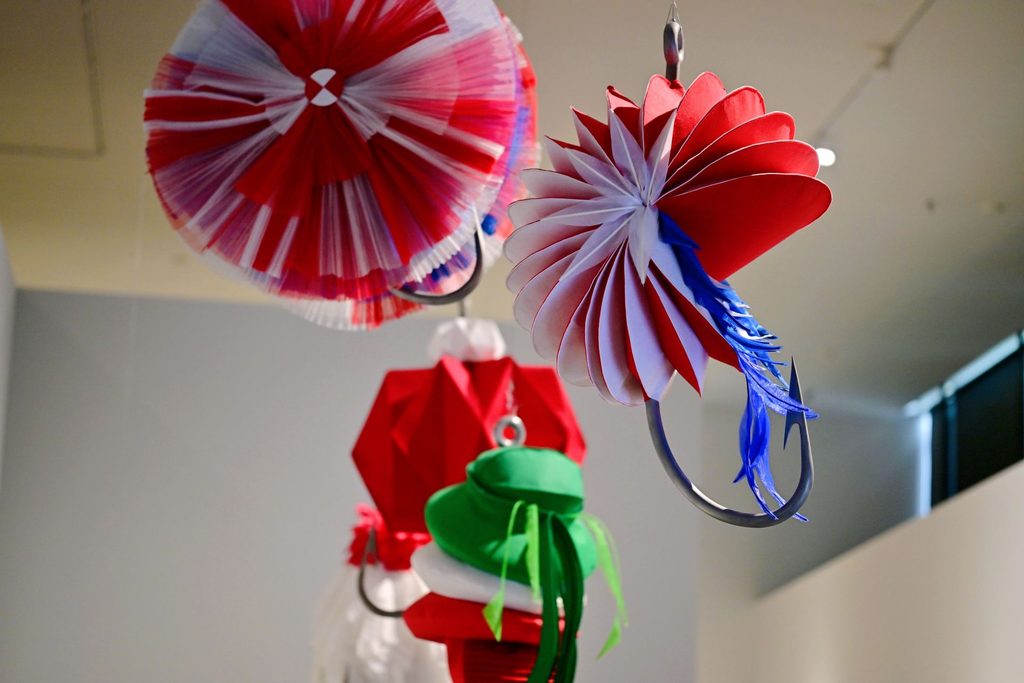
When I first saw the fishhooks in her work, I immediately thought of temptation, attraction, and the danger of getting trapped in a relationship.
So I asked her a pretty direct question:
“Do you see yourself as the fish, or the hook?”
“We can be both the fish and the hook.”
But as our conversation continued, it became clear that she was talking about something much bigger than personal relationships.
What Luo Li really wanted to explore was the information-driven world we live in. All these things competing for our attention and stirring up our emotions—where are they actually leading us?
A Fishing Trip That Sparked an Idea
The idea for Luo Li’s work came from a fishing trip with friends.
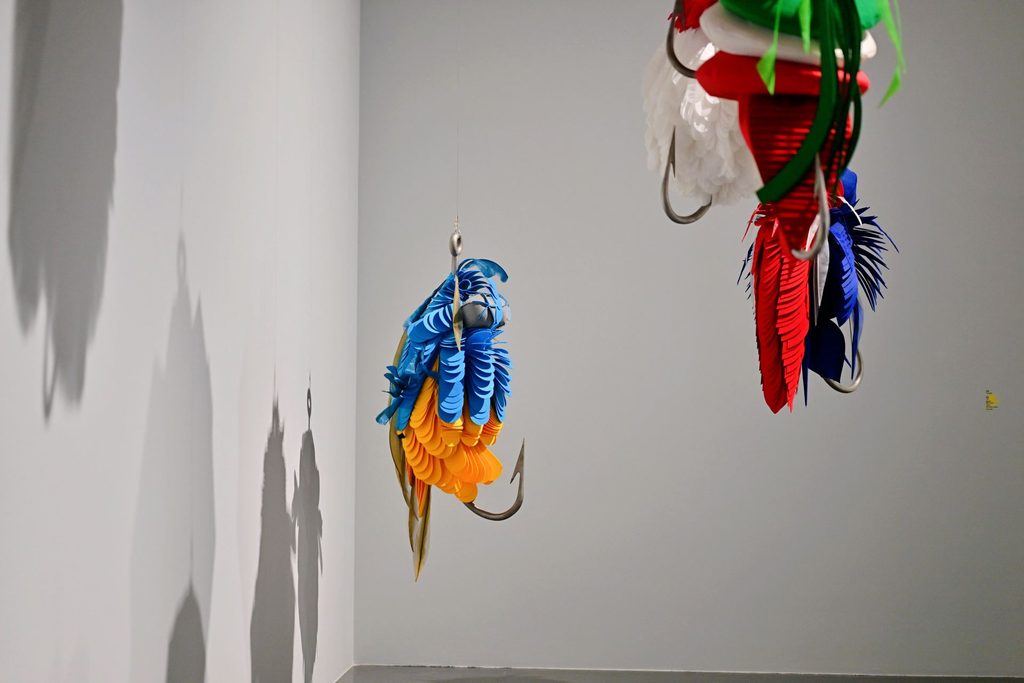
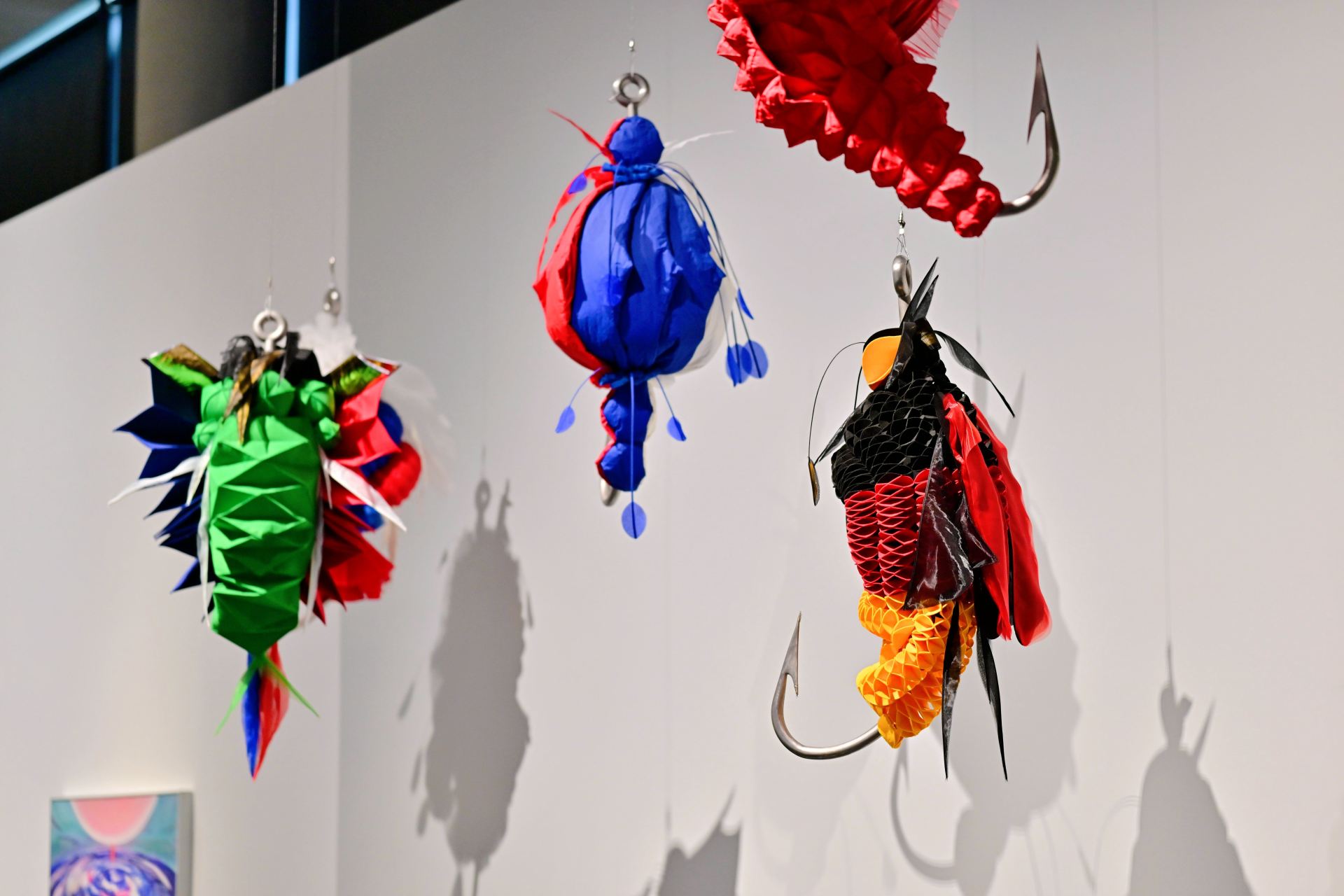
They had gone lure fishing at a lake outside Chengdu. One of her friends opened up a tackle box filled with artificial fishing lures. There were all kinds of shapes and colors. Some were incredibly detailed, and others were handmade.
At first, she was simply drawn to how beautiful they were.
Then something struck her.
People had put so much thought, creativity, and effort into making these beautiful little objects, all for the purpose of catching fish.
Through observation and experience, people had learned that some fish were attracted to shiny, flashing objects, while others responded to insects or worms. Each lure was carefully designed around the behavior of a particular kind of fish.
The attraction was intentional. And the danger was hidden inside it.
That realization made her think about the world of information and media we live in.
She had long been aware that we experience much of the world through what she describes as a kind of “symbolic reality.”
The information we receive through the media isn’t necessarily a direct reflection of the world as it really is. Information gets selected, framed, interpreted, and sometimes distorted.
Over time, these versions of reality become what she calls “pseudo-realities,” shaping how different groups understand the world.
And with the rapid development of AI, she believes these manufactured realities will become even more powerful and convincing.
“We don’t sense the danger because it’s packaged to look like something we already love.”
Who’s Really Controlling Our Emotions?
I followed up by asking whether the fish and the hook had anything to do with her own need for freedom or self-protection.
Luo Li took the conversation in another direction.
She talked about how a single piece of information can instantly make us feel happy, sad, angry, or anxious.
Sometimes the content seems to understand us perfectly. It speaks directly to our emotions, our fears, or something we deeply want to believe.
But when we dig deeper and try to find out what actually happened, we may discover a completely different story.
By then, we’ve already reacted emotionally, even though we may not fully understand the situation.
What interests her is the enormous flood of words, images, and videos competing for our attention every day.
Their power, she believes, comes from how precisely they target our most basic ways of seeing, feeling, and responding.
And she worries that these mechanisms could fundamentally change how we think, behave, and experience the world in the future.
Making the Hooks Bigger Changes Everything
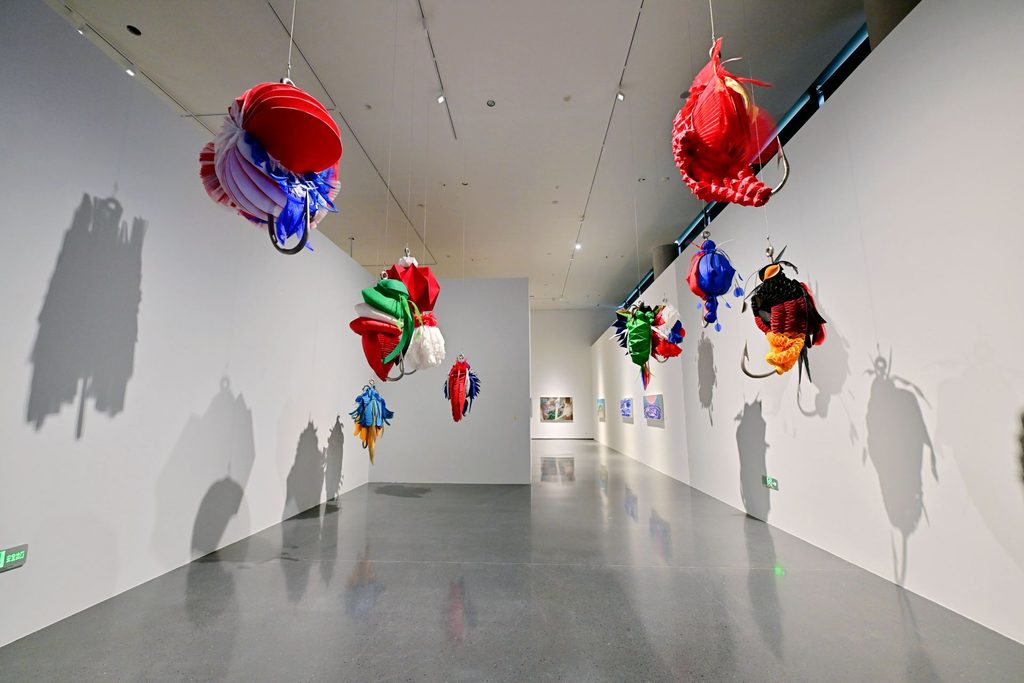
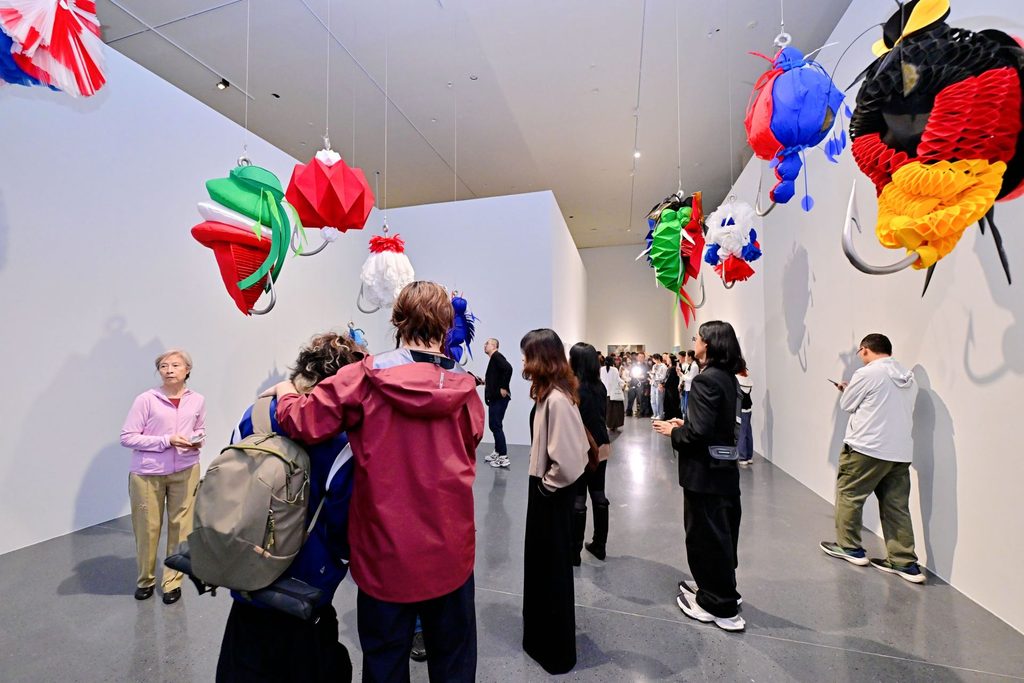
Two things immediately stand out in Luo Li’s work: imitation and color.
Her sculptures are bright, visually appealing, and almost playful at first glance.
They seem to offer something beautiful.
But Luo Li deliberately avoided making them small enough to hold in your hand.
She felt that if the objects were too small and delicate, viewers might focus only on their craftsmanship and decorative qualities.
The hooks would become beautiful little objects, with no obvious connection to the people looking at them.
Once she enlarged them, that relationship changed.
Standing beneath one of these oversized hooks, you become physically aware of its presence. You start to see yourself differently in relation to the object.
That’s exactly the shift she wants to create.
First, you’re attracted by its beauty.
Then you look more closely and notice the sharp edges and the danger hiding beneath the surface.
For Luo Li, that moment of recognition is important.
Unlike an actual hook, the sharpness of an artwork doesn’t physically hurt you or trigger an instinctive reaction.
Instead, it can create awareness. It can make you stop, think, and question what you’re seeing.
Sometimes Painting Says What Words Can’t
When I asked Luo Li why she was drawn to art in the first place, she went back to her childhood.
She described herself as a quiet, introverted kid who often spent time drawing.
Some of the things she wanted to express felt more like dreams, fantasies, or fragments of imagination. They were difficult to explain in words, but she could put them into a painting.
As she grew older, her questions became more complicated.
She began thinking about how to express not only emotions, but also her understanding of life and the situations people find themselves in.
How do intuition and reason work together?
And how are our personal feelings connected to the society around us?
Those questions continue to shape her practice.
In this exhibition, her focus moves beyond personal experience toward the much larger environment of media, information, and communication.
When we talked about whether women’s inner experiences could simply be described as “sensitive” or “vulnerable,” she pointed out that there are still many subtle feelings that are difficult to put into words.
She hopes to find forms that allow those qualities to come through in her work.
Art, for her, offers a way to express things that haven’t yet been clearly named.
From Independent Art Communities to Finding Her Own Language
Our conversation also turned to the city where Luo Li lives and the independent art communities that have shaped her experience.
She recalled her early years after returning to China, when she was involved with an artist-run group called Beicun Independent Workshop.
It was a community of artists who regularly got together to talk about books they’d been reading, new work they were making, and ideas they wanted to explore.
Those conversations sometimes grew into exhibitions.
The artists would work together to develop the concepts, find spaces, raise money, install the work, and make the exhibitions happen.
Usually, one or two especially motivated members would take the lead, with everyone else contributing and supporting one another.
She remembers that time fondly.
What made those exhibitions possible wasn’t a formal institution or a commercial plan. It was the exchange of ideas between artists and a shared desire to express something they cared about.
When I asked whether she preferred working with a particular medium, she explained that she doesn’t focus on any single one.
Her practice has always been shaped by questions about people and their relationship with society.
If an idea works best as a video, she’ll make a video.
If it needs to become an installation, she’ll create an installation.
Sometimes painting makes more sense. Other times, sound might be the right way to express it.
For her, the medium comes after the idea.
What matters most is what keeps an artist creating, and how they find the right visual or artistic language for what they want to say.
That openness to different forms of expression runs throughout her practice.
Exhibition Information
Exhibition: Growing Inward — A Group Exhibition of Contemporary Women Artists
Curator: Lu Peng
Dates: October 10 – November 22, 2026
Venue: Chengdu Art Museum, Building B, Gallery B2
Interview: Tan Xiaozheng / BACKWALL
Interview date: October 10, 2026
This article is based on an on-site interview with Luo Li conducted by Tan Xiaozheng on October 10, 2026. Repetitions and conversational language have been lightly edited for clarity. Images courtesy of the exhibition organizers.