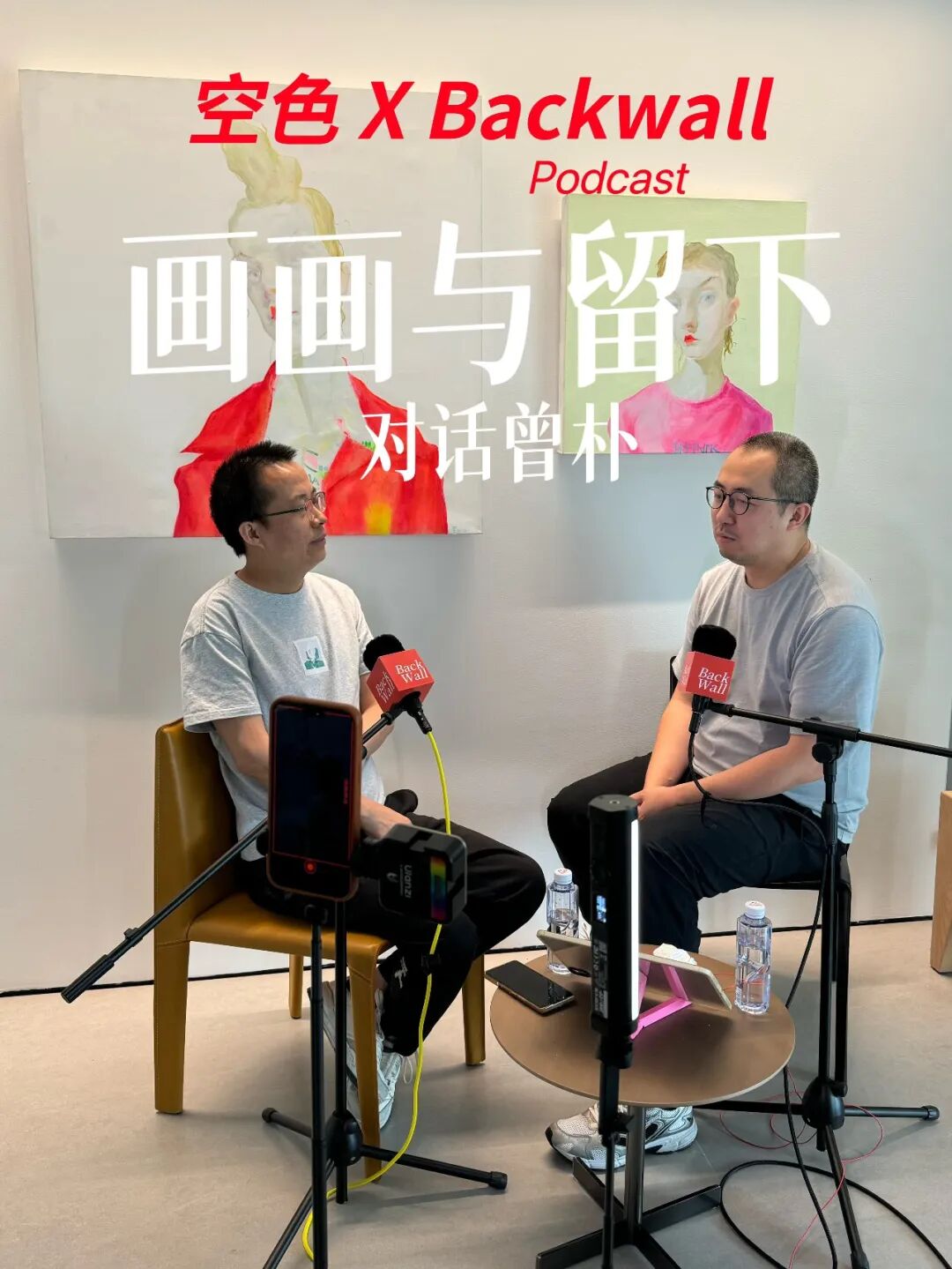
A conversation between artist Zeng Pu and Tan Xiaozheng
What makes someone choose to be an artist?
Not for one year.
Not for a successful exhibition.
Not for recognition.
But for twenty years.
In July, Backwall Podcast visited artist Zeng Pu’s solo project exhibition “Empty Color” (《空色》) in Chengdu.
Instead of a traditional white cube gallery, the exhibition took place inside a design studio — a space closer to everyday life, work, conversation, and people.
That setting actually matched the conversation.
This was not a typical artist interview about achievements, prices, or career milestones.
It was a conversation about something much simpler:
How does painting become a way of living?
“I just wanted to keep painting.”
Zeng Pu started his journey from Xichang, a small city in Sichuan Province, and later studied oil painting at Sichuan Fine Arts Institute.
After graduation, he did not choose a more stable career path.
He kept painting.
For more than twenty years.
Looking back, he describes the journey simply:
“Painful, but also joyful.”
It is not a dramatic artist story.
There is no sudden breakthrough moment.
No overnight success.
Instead, it is about showing up every day.
Painting.
Reading.
Looking.
Thinking.
This reminds us that being an artist is not only about inspiration.
It is about commitment.
Staying away from the center
For many artists, the question is always:
Should I move to the center?
New York.
London.
Paris.
Shanghai.
Beijing.
Art history has always been connected with major cultural centers.
But Zeng Pu eventually chose to return to Chengdu after spending time working in Shanghai.
Not because Shanghai was unimportant.
He recognizes that Shanghai has a more mature art ecosystem, stronger gallery networks, and a longer history of collecting.
But life changes.
As he said, when you reach middle age, you have family, responsibilities, and deeper connections to a place.
More importantly, today’s world is different.
With the internet, transportation, and global communication, an artist does not necessarily have to live in one specific center.
The real question is:
Can you continue making meaningful work?
Can your ideas keep growing?
From “Heart” to “Are You Happy?”: Turning Images into Paintings
The second part of our conversation moved into Zeng Pu’s paintings.
From his early series “Heart” to his later works “Are You Happy?”, his paintings have always focused on people.
But these are not traditional portraits.
He is not trying to record a specific person.
He is interested in something more universal:
Human emotions.
Human conditions.
The feeling of living in a changing world.
The artist as a collector of images
Where do paintings come from?
For Zeng Pu, the answer is simple:
From looking.
He collects images from everywhere:
Movies.
Magazines.
Online photographs.
Public images.
Everyday life.
Over time, these images become a personal archive.
Not a database.
Not just references.
A memory of seeing.
His process is simple:
Look.
Save.
Observe.
Wait for a moment that creates a feeling.
Then transform it into painting.
Painting faces without identity
Many people notice that the figures in Zeng Pu’s paintings often appear with a global feeling.
Some viewers ask:
“Are they Western characters?”
But Zeng Pu explains that nationality is not the point.
He is not painting “Western people” or “Eastern people.”
He is searching for something shared.
A human quality.
A common emotional state.
Growing up in the 1980s, his generation experienced a rapidly globalizing world.
Foreign films.
Literature.
Rock music.
Fashion.
The internet.
All these images shaped how they saw the world.
Today, images travel across borders instantly.
People everywhere share similar visual experiences.
His paintings reflect that condition.
Art History: A Resource, Not a Prison
During the conversation, we also discussed the relationship between artists and art history.
Does an artist need to understand history?
Zeng Pu believes yes.
Every artist exists inside a larger cultural timeline.
But he also warns against becoming trapped by the desire to create “the next big thing.”
Sometimes artists become too focused on positioning themselves in history.
They start creating for theories instead of real experience.
For Zeng Pu, the most important thing is still:
Stay connected to your own feelings.
Knowledge matters.
But intuition matters too.
What Happens to Painting in the Age of AI?
Today, anyone can create images with AI.
So what is the value of painting?
Zeng Pu does not see technology as the end of painting.
Art history has always changed with technology.
Photography changed painting.
Film changed visual culture.
Digital media changed images.
AI is another transformation.
But painting is not only about producing an image.
It is about human experience.
The time spent looking.
The choices made.
The relationship between a person and the world.
You Don’t Have to Understand Art to Enter Art
One of the most interesting parts of our conversation was about audiences.
Many people feel uncomfortable in front of contemporary art.
They think:
“I don’t understand it.”
“Maybe I’m not educated enough.”
“Maybe I don’t belong here.”
But Zeng Pu believes:
That is completely normal.
Even artists sometimes encounter works they do not immediately understand.
Art is not an exam.
You do not need the right answer before entering.
Think about music.
We don’t need to understand music theory before enjoying a song.
We first feel something.
Then we become curious.
Art can work the same way.
Look first.
Feel first.
Understand later.
Painting and Staying
After twenty years, Zeng Pu’s story is not about becoming a famous artist.
It is about something quieter.
Continuing.
Keeping curiosity.
Keeping the ability to see.
In a world full of endless images, perhaps the most valuable skill is not creating more images.
It is learning how to truly look.
Maybe the answer is still the simplest one:
“I just want to keep painting.”
Tan Xiaozheng Field Notes
Recording real conversations with artists, creators, and people shaping culture.
Guest: Zeng Pu
Artist, Chengdu
Host: Tan Xiaozheng