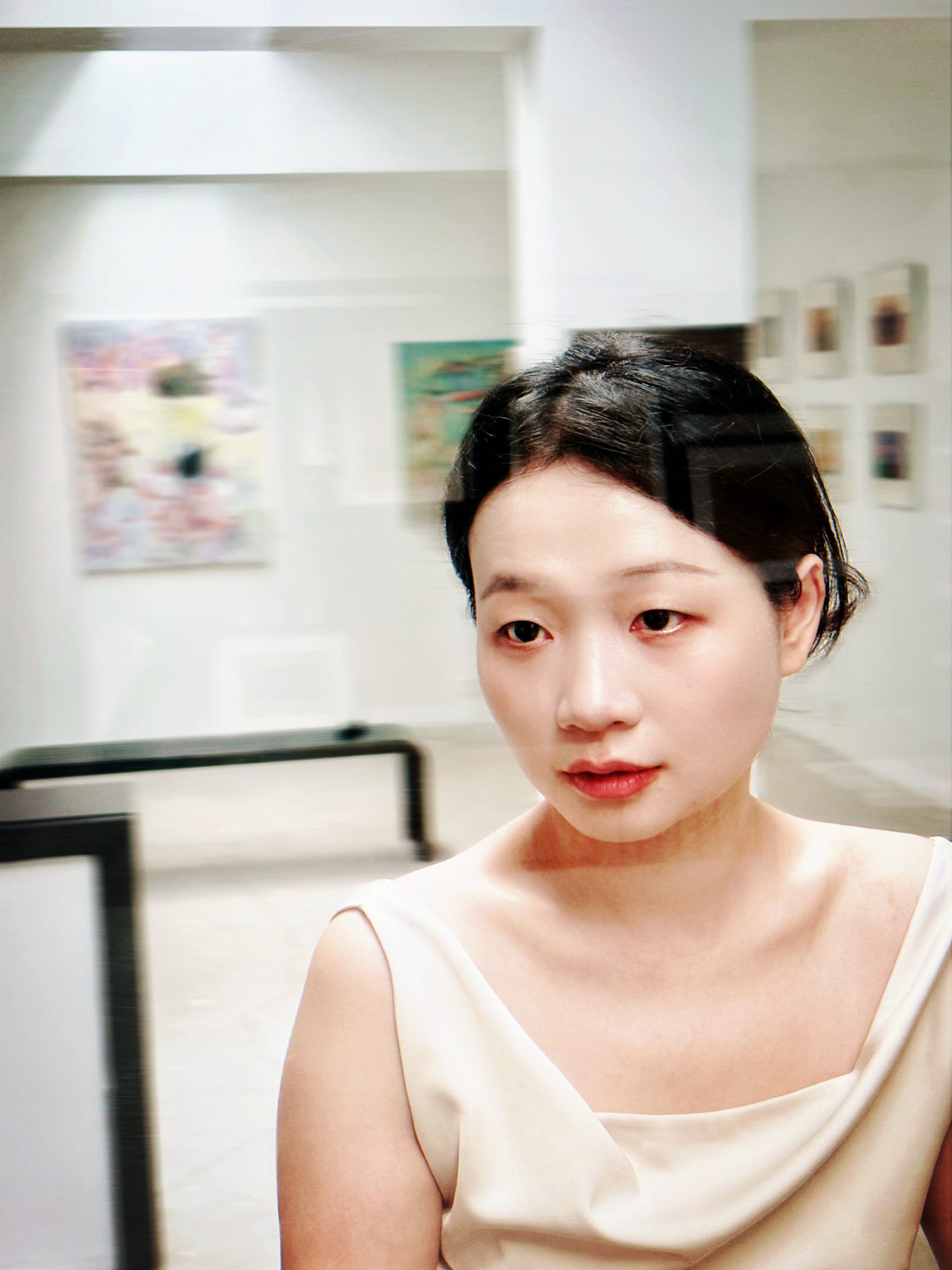
On rabbits, artistic identity, and the evolving contemporary art landscape in Chengdu — an interview with Tang Ying on the opening of Alice in Non-Euclidean Space
Rabbits Are Not Symbols of Cuteness — They Represent a Way of Being
On July 25, 2026, Garage Apart Chengdu opened the dual exhibition Alice in Non-Euclidean Space, featuring artists Li Yaming and Tang Ying.
The exhibition explores another way of seeing beyond familiar systems of reality — how space, bodies, emotions, and identities can be reshaped when traditional structures begin to shift.
If Li Yaming’s paintings resemble carefully constructed dreams, Tang Ying’s works remain closer to the moment before emotions are fully translated into language.
She paints rabbits.
But the rabbits in her paintings are not simply cute or comforting figures.
They are sensitive, alert, and vulnerable — yet they also carry a sense of resistance, defense, and strength.
As described in the exhibition text, Tang Ying’s rabbits appear repeatedly among rough brushstrokes, layered colors, and fragmented grids. They lean toward each other, turn away, confront one another, and constantly maintain their own distance.
During our interview, Tang Ying explained:
“A rabbit is not just a cute image that people usually associate with. It also represents resilience — a kind of courage that refuses to give up.”
From Artist to Active Participant in the Art Scene
The first time I met Tang Ying was at an art event in Chengdu.
My first impression was quite unexpected:
She looked young and gentle, but she was managing a surprisingly complex life.
Artist, university lecturer, exhibition organizer, and participant in curatorial projects — all of these identities exist together within this post-95 generation artist.
But Tang Ying does not see herself as intentionally creating a “multi-role identity.”
Her journey began with painting.
While studying in graduate school, she frequently visited exhibitions and became involved in exhibition writing, interpretation, and promotional work. Through these experiences, she gradually learned how an exhibition moves from an idea into a real public experience.
Around 2023, she organized her first commercial exhibition project, ZOO: Li Ming Solo Exhibition, hoping to bring installation art closer to everyday audiences.
Her original intention was simple:
To make art more accessible.
However, the experience also taught her important lessons.
One of them was about ticket pricing.
“The ¥19.9 tickets sold out very quickly, but after the price increased, the result was not as expected.”
For Tang Ying, this became a valuable reminder:
Art communication is not only about the artwork itself.
It is also about understanding the relationship between people and art.
An exhibition is not simply about placing artworks in a space — it is about creating a connection.
An Artist’s Ability to Connect With People Is Also Part of Their Practice
Many artists are used to working alone in their studios.
But Tang Ying seems naturally able to connect with people.
At Chengdu’s art events, she quickly builds conversations with different artists.
Yet she does not describe this as “social skills.”
She believes it comes from something simpler:
“Maybe it is just being sincere and expressing what you truly think.”
For Tang Ying, the foundation of communication between artists is:
Curiosity about the work.
Interest in the person behind the work.
And genuine respect.
Rather than building relationships strategically, she believes connections should begin with authentic interest in art and people.
How Does One Person Balance Teaching, Creating, and Living?
Today, Tang Ying is not only an artist but also a university art lecturer.
Teaching, research projects, mentoring students, personal creation, and exhibition activities all exist within her daily life.
Her solution is not to separate these identities completely, but to discover the connections between them.
“Teaching is also part of my professional field, so many things actually belong to the same system.”
For her artwork, however, she believes consistency is essential.
She sets aside dedicated time for painting and brings everyday experiences, emotions, and observations into her work.
“I put my emotions into my paintings, and then combine them with experiences from daily life.”
For Tang Ying, being a teacher and being an artist are not conflicting roles.
Teaching allows her to observe younger generations, while life experiences continuously return to her creative practice.
Why Rabbits?
Tang Ying’s first rabbit painting came from an unexpected moment.
During an exhibition, she encountered a rabbit.
She found it adorable and brought it back to the exhibition space.
After raising it for a year and a half, the rabbit died in an accident.
The sadness she experienced led her to begin painting it.
At first, it was simply a way of remembering.
But gradually, she discovered something deeper:
The rabbit reflected aspects of her own personality.
Sensitive.
Alert.
But also brave.
It became more than a pet.
It became a personal metaphor.
“It has its own stubbornness. It refuses to give up. It doesn’t care too much about how others see it.”
This is why Tang Ying’s rabbits are not weak or passive figures.
Their softness contains strength.
Alice in Non-Euclidean Space: A Meeting Between Two Young Artists
For this exhibition, Tang Ying presents her work alongside artist Li Yaming.
Their artistic languages are very different.
Li Yaming creates dreamlike worlds through geometric structures and carefully organized compositions.
Tang Ying works more directly through color, texture, and the emotional presence of rabbits.
But they share something important:
Both artists are creating worlds beyond ordinary reality.
Tang Ying says:
“We have similar personalities. We are both relatively quiet at first, and we gradually built mutual understanding through our work.”
Although their visual languages differ, both artists create a sense of dreamlike space.
This contrast and connection become one of the entry points into Alice in Non-Euclidean Space.
Chengdu Needs More Art Spaces Embedded in Everyday Life
The exhibition takes place at Garage Apart Chengdu, located inside a residential community in Chengdu.
Compared with large museums and commercial galleries, this kind of small-scale art space offers another possibility.
Tang Ying believes Chengdu’s art ecosystem is developing through different layers.
There are established galleries, museums, and also smaller spaces that connect directly with local communities.
However, the art market still requires long-term cultivation.
“Many people think original artworks must be extremely expensive.”
But in reality, art consumption can exist at many levels.
Helping more people understand art, purchase art, and bring original works into their homes requires long-term cultural education.
Advice for Young Artists: Survive First, Then Continue Creating
As a teacher, Tang Ying often encounters students who dream of becoming artists.
Her answer is realistic.
First:
“Survive.”
Because relying only on selling artworks remains difficult for many young artists today.
Her suggestion is:
Have an independent profession while continuing artistic practice.
This is not a compromise with art.
Instead, it allows art to have a longer life.
“Art begins with love. You have to truly love it, and then keep investing your time and energy.”
Final Thoughts
Tang Ying represents a new generation of artists.
She is not simply waiting to be discovered.
She participates in exhibitions, connects with other artists, engages with audiences, and builds her own everyday life.
She paints rabbits.
But ultimately, she is painting a state of being:
Sensitive, but not fragile.
Soft, but with boundaries.
Independent, yet willing to connect with the world.
Perhaps this is also what Alice in Non-Euclidean Space asks:
When our familiar scales and systems begin to shift, how do we find our own position again?
Alice in Non-Euclidean Space
Artists: Li Yaming, Tang Ying
Curator: Johnnie Cheang
Duration: July 25 – August 23, 2026
Venue: Garage Apart Chengdu
14-9-5, Shuanglin Henglu Road, Chenghua District, Chengdu, Sichuan, China