By Xiaozheng Tan | BACKWALL
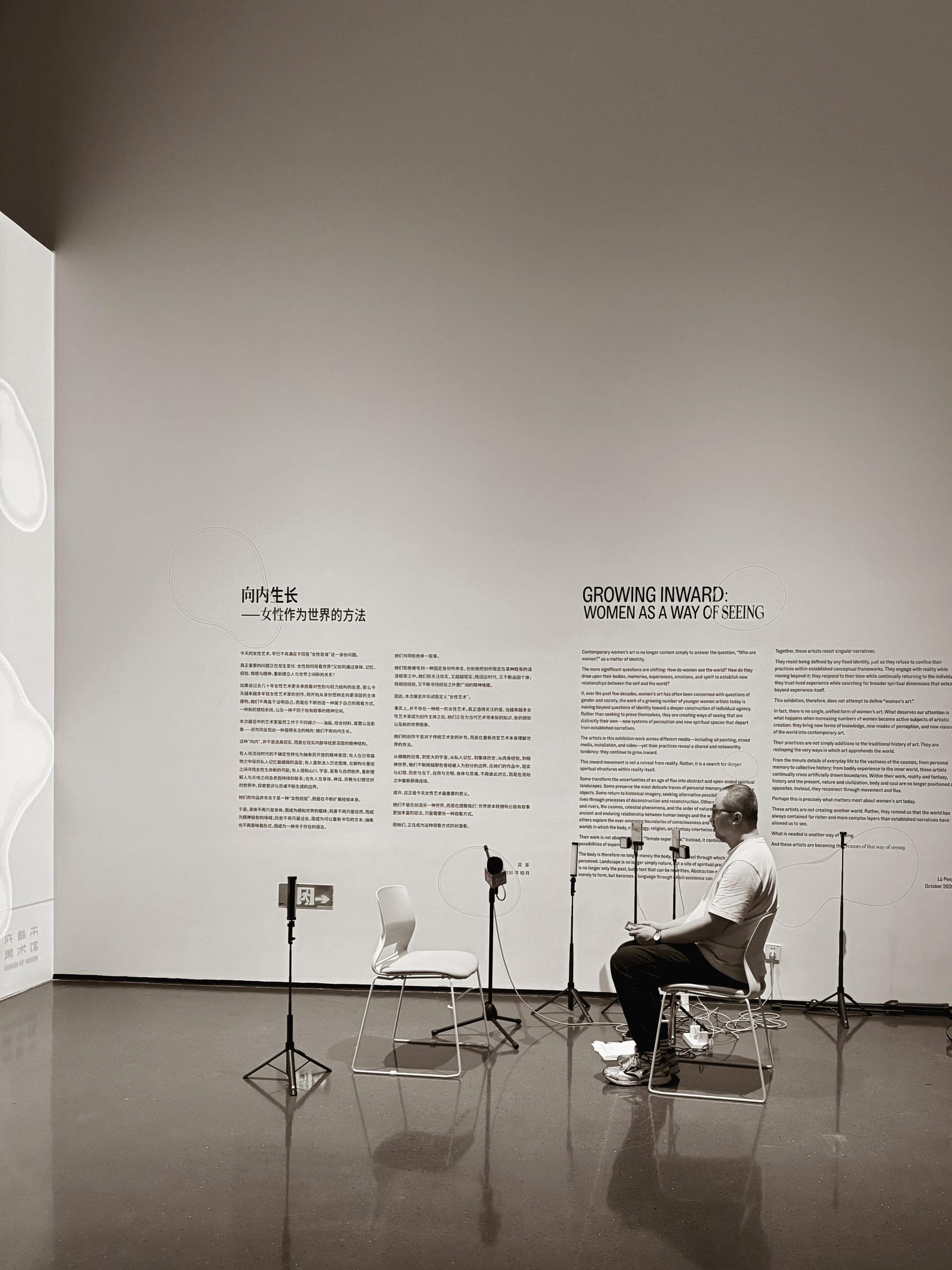
On October 9 and 10, I interviewed eight women artists featured in Growing Inward, an exhibition at the Chengdu Art Museum. These conversations were made possible in part by the trust and support of curator Lü Peng.
Wang Zhenghong, Zhu Keran, Yu Shanshan, Yan Yun, Tian Yuanyuan, Song Yulin, Luo Li, and Lin Kaixuan.
Eight conversations. Eight different ways of getting closer to the work, and to the people behind it.
I asked questions, listened, followed up, and then turned hours of recordings into transcripts and articles. Over those two days, the interviews and the writing happened almost back to back.
Getting so much done in such a short time felt satisfying. It was also exhausting.
And the work didn’t end when the interviews were over.
I kept going back to certain answers. Some passages needed another listen. Some of my interpretations needed to change. And sometimes, just one sentence from an artist made me realize I had to look at her work all over again.
That was probably my biggest takeaway from these two days:
We can produce content quickly. But understanding something takes time.
I Came With Questions. I Left With Different Ones.
When I first walked through the exhibition, a few words came to mind: destruction, disorder, temptation, control, and unease.
I wondered whether the tension and sharp edges in these works came from a need for self-protection. I wanted to understand how qualities often associated with femininity, like softness and vulnerability, might become sources of creative strength.
Those questions helped me find a way into the work.
But once I actually sat down with the artists, I realized something.
My questions were also limiting what I could see.
Their answers changed the direction of our conversations.
One artist challenged my assumption that growth meant reaching outward. For her, it was more about looking within.
Another reminded me that her work went far beyond personal emotions.
Someone else didn’t want her work reduced to a conversation about vulnerability.
And another made me think about why we insist on looking at someone as a woman artist before simply seeing her as an artist.
In his introduction to the exhibition, curator Lü Peng raises a question worth considering: How do women see the world? And how do they build new relationships with it through their bodies, memories, lived experiences, emotions, and inner lives?
After reading his essay and revisiting these eight interviews, I began to understand something more clearly.
These artists don’t need to represent a single idea of womanhood.
Their different experiences, choices, and ways of expressing themselves are exactly what give this exhibition its depth.
And perhaps that’s what makes an interview worthwhile.
It doesn’t just confirm what you already think.
Sometimes, it forces you to rethink everything.
Eight Artists, Eight Ways of Looking Inward
Wang Zhenghong: Growth Begins Within
For Wang Zhenghong, growing inward means paying attention to what you genuinely think and feel. It’s about developing your inner world before allowing the work to grow naturally from it.
The image of a bird might immediately suggest flight and freedom.
But our conversation reminded me that I shouldn’t let one familiar symbol determine what an artwork means.
Sometimes growth isn’t about flying away.
It’s about understanding where you are.
Zhu Keran: Finding Warmth in Ice
Water flows. Glaciers freeze.
In Zhu Keran’s work, these different states of nature carry different kinds of strength.
Something soft can hold tremendous weight. Something frozen can contain powerful energy.
Her observations of the natural world, together with her reflections on personal experience, bring an unexpected warmth to images that might otherwise seem cold.
Yu Shanshan: Making the Familiar Strange Again
Yu Shanshan’s Wang Wu (妄物) opens up a world where recognition is never quite certain.
We’re used to looking at something, identifying it, and immediately giving it a name.
Her work interrupts that habit.
It makes us hesitate.
And in that small gap between seeing something and deciding what it is, there’s room for imagination.
Yan Yun: Giving Inner Conflict a Visual Form
Colors flow, structures twist, and different elements pull against one another in Yan Yun’s paintings.
Gradually, emotion takes shape.
She talked about making art, but also about choices, patience, and becoming more certain of herself.
The sense of order in her work isn’t something she simply starts with.
It’s something she discovers through constant adjustment.
Tian Yuanyuan: Leaving Questions Open
Tian Yuanyuan explores memory, the body, and our inner experiences.
She also made me reconsider how casually we use words like “broken” or “fragmented” to describe an artwork.
What does it really mean to put something back together?
How does an experience change when we revisit it?
And does everything need to be explained?
Talking with her reminded me that some questions deserve to remain open.
At least for a while.
Song Yulin: Time Beneath the Surface
In Song Yulin’s work, covering something up or rebuilding it doesn’t mean the past disappears.
Earlier experiences remain beneath the surface, interacting with whatever comes next.
Every new line carries traces of time, emotion, and physical movement.
The past isn’t erased.
It becomes part of what we’re seeing now.
Luo Li: The Beautiful Bait That Makes Us Look
At first, I wanted to approach Luo Li’s work through personal relationships and emotional attachment.
But she took our conversation somewhere else entirely: toward information, media, and temptation.
Why are we drawn to beautiful things?
What captures our attention?
And how much control do we really have over what we choose to look at?
Her imagery of hooks and bait isn’t just about attraction.
It also raises questions about the endless stream of information competing for our attention every day.
Lin Kaixuan: Drawing Her Way Through Inner Conflict
From historical images of women to the anxiety, expectations, and restrictions she’s encountered in her own life, Lin Kaixuan continues to search for a visual language that feels true to her.
Her tangled lines become traces of an ongoing conversation with herself.
Feelings that are difficult to put into words find a shape on the canvas.
Something internal becomes visible.
Eight interviews didn’t give me one neat conclusion.
Instead, they left me with eight different ways of thinking, and quite a few questions I still need time to process.
Once the Rush Was Over, the Exhaustion Set In
AI played a role in organizing the material from these interviews.
Transcribing recordings, sorting through conversations, restructuring paragraphs, refining headlines, and putting articles together — all of that became faster.
Drafts that once took much longer to prepare could now appear in front of me almost immediately.
But here’s what I noticed.
The faster the first draft comes together, the more human judgment gets packed into a shorter amount of time.
Is this sentence accurate?
Is this actually what the artist meant, or is it my interpretation?
When I clean up someone’s spoken words, am I also removing their hesitation, uncertainty, or the subtle distinctions they were trying to make?
And in trying to make an article read smoothly, have I turned an open question into a statement that sounds far more certain than it should?
That’s where much of the exhaustion came from.
Even after the writing looked finished, I had to go back.
Back to the recordings.
Back to the context of each question.
Back to the moments when an artist corrected a word or challenged an assumption.
The article might have been finished on the page.
But my understanding was still catching up.
AI made the production process faster.
It also made one thing very clear:
The responsibility for judgment still belongs to us.
In the Age of AI, We Need Time to Think
Over those two days, the exhibition’s title, Growing Inward, started to feel like a reminder about my own work.
Interviewers need to look inward, too.
Why did I ask that question?
Was I too eager to find one theme that would connect all eight artists?
Was I really listening when someone gave me an answer I hadn’t expected?
When technology makes it possible to produce content almost endlessly, it’s easy to get caught up in the pace.
Another article.
Another headline.
Another video.
Finish one thing, move straight to the next.
But some ideas only become clear after the work slows down.
I’d like to use the time AI saves me to listen one more time, think a little deeper, and give the work some room to exist without immediately turning it into a neat explanation.
To let a powerful answer keep its complexity.
To let an unanswered question stay unanswered.
And to remember that not everything valuable needs to be processed at maximum speed.
I’ll be sharing the eight artist interviews over the coming days.
These articles document how the artists talk about their work. They also document how listening to them changed the way I see it.
I hope that after reading them, you’ll want to visit the exhibition yourself — and maybe spend a little longer standing in front of each piece.
The interviews took two days.
The thinking they started will take much longer.
Exhibition Information
Growing Inward — 2026 Contemporary Women Artists Group Exhibition
Curator: Lü Peng
Dates: October 10 – November 22, 2026
Venue: Chengdu Art Museum, Building B, Gallery B2, Chengdu, China
Individual interviews with all eight artists will be published soon.
Editor’s Note: This article draws on interviews with eight participating artists and the exhibition’s curatorial introduction. The reflections on looking at art, interpretation, and human–AI collaboration are my own.