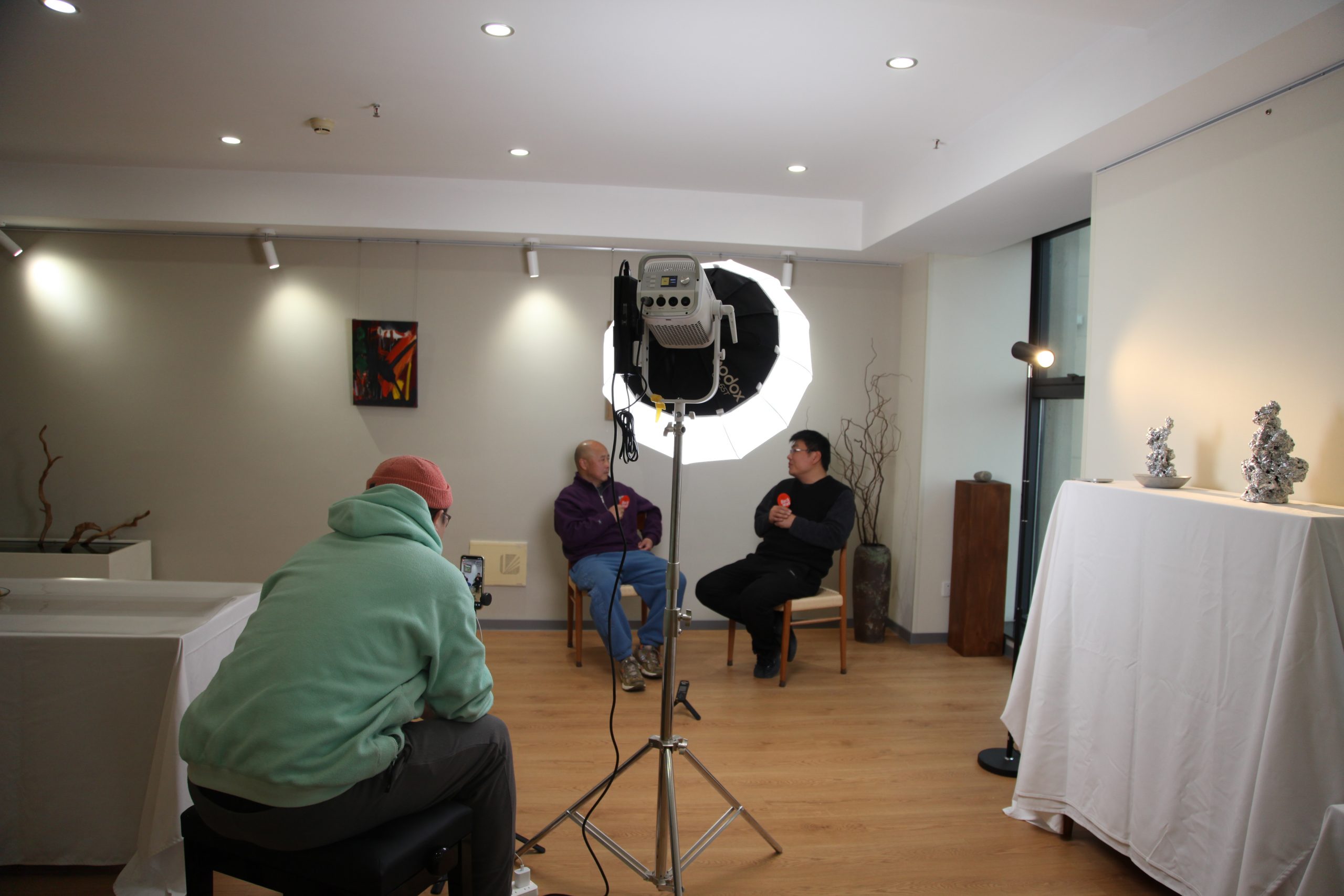
Date: January 5
Location: Xiaolu Cross-Disciplinary Art Space
Event: Opening of the contemporary art exhibition Otherlands & BACKWALL’s first official live-stream documentation
This was the first time BACKWALL used live streaming as a way to systematically document an exhibition in the making.
There was no script, no preset outcome. When the camera went live, artists were still installing their works, the curator was moving back and forth coordinating details, and the space itself was still in motion. What we did was simple: we kept the camera on and let the conversations remain.
Based on three interview documents recorded on the same day (Interview Documents 1, 2, and 3), this article is organized into three chapters, following the actual sequence in which events unfolded.
Chapter One | Before the Exhibition Opens: How Artists Talk About Their Work
(Interview Document 1)
Time: Morning, during installation
Host: Tan Xiaozheng, Editor at BACKWALL
Participating Artists:
- Cui Rongliang | Sculptor, exhibiting artist
- Wei Shulong | Exhibiting artist
- Qian Long | Exhibiting artist
When the live stream began, the exhibition was still being installed.
The lighting had not yet been fully adjusted. Artists were brought into the frame one by one, informally introducing their works and recent practices. This was not a formal interview, but rather an on-the-spot record made before the exhibition fully took shape.
Cui Rongliang appeared first. He spoke about the two metal sculptures he presented in Otherlands. Their forms sit somewhere between stone, remnants of casting processes, and naturally generated structures. Rather than directly imitating nature, the works intentionally use human-made traces to simulate natural ones.
For him, the act of making did not point toward a fixed conclusion:
“When I’m working, I don’t think too much about where it’s going. I just make the object. Time passes very quickly in the process.”
Wei Shulong and Qian Long focused more on their individual paths—moving between academic training, economic reality, and the need to sustain long-term artistic practice. They did not avoid discussing teaching, commercial work, or other forms of livelihood.
In this chapter, BACKWALL did not attempt to “interpret” the works. Instead, the focus remained on how artists describe themselves:
- Why do they continue making art?
- How do they sustain practice within real-life constraints?
- Is “persistence” still a useful word?
This reflects BACKWALL’s ongoing approach: to record people first, and revisit the works later.
Chapter Two | Curating and Space: How an Exhibition Is Carried
(Interview Document 2)
Time: 1:00 PM
Participants:
- Liu Shi | Curator of Otherlands
- Xiaolu | Founder and director of Xiaolu Cross-Disciplinary Art Space
This conversation took place after the exhibition structure was largely in place.
Liu Shi began by outlining the curatorial background of Otherlands. Rather than starting from a single academic theme, the exhibition brings together diverse artistic states to reflect the multiplicity of contemporary practice.
Xiaolu, speaking from the perspective of a space founder, approached the discussion differently.
He reflected on the original intention behind Xiaolu Cross-Disciplinary Art Space: a venue that integrates music, visual art, poetry, and dialogue. Instead of functioning solely as a “white cube,” the space positions itself as a continuously active node within the community.
In his view, an art space is not merely a site for displaying outcomes, but a place that:
- Allows more people to encounter art
- Encourages natural intersections between disciplines
- Makes art something that can be entered repeatedly as part of everyday life
Liu Shi added that curating is not simply about “selecting artists,” but about navigating real conditions and maintaining balance:
- Avoiding stylistic limitation
- Avoiding indiscriminate inclusiveness
- Maintaining long-term direction and contemporary relevance
In this chapter, the conversation shifts from artworks to structure—how exhibitions are placed, how spaces intervene, and how curating becomes a form of sustained action.
Chapter Three | Speed, the Body, and Sustainability: A Dialogue Between Curator and Artists
(Interview Document 3)
Time: Late afternoon
Participants:
- Liu Shi | Curator
- Liang Bo | Sculptor from Ningbo, exhibiting artist
- Cui Rongliang | Sculptor
- Tan Xiaozheng | Editor, BACKWALL
This segment begins with a direct question:
“Don’t you think the pace of your exhibitions is too fast?”
Hosting an exhibition every two weeks is uncommon in today’s art ecosystem. Liu Shi did not avoid the issue. He described “speed” as a pragmatic strategy:
- To make more artists visible
- To bring practices into public view quickly
- To search, through constant movement, for moments where slowing down becomes possible
Liang Bo responded from the perspective of an artist.
He spoke about sculpture as a practice that depends heavily on physical labor, time, and material costs. In recent years, he has shifted toward ceramics and smaller-scale works, reconnecting with folk traditions and everyday experiences.
“If basic survival cannot be sustained, then talking about creation itself becomes meaningless.”
Cui Rongliang returned to the idea of interruption—pauses, detours, and restarts in artistic practice. These, he suggested, are not failures but shared experiences among many artists.
This chapter does not attempt to resolve these issues. Instead, it preserves the questions as they were spoken:
- How do we protect the body while maintaining speed?
- How do we continue making work under real conditions?
- How can exhibitions function as long-term processes rather than one-off events?
Epilogue | An Unedited Beginning
This was BACKWALL’s first live stream.
It was not smooth. It was not polished.
But because it unfolded during installation, mid-conversation, and before anyone was fully prepared, it came closer to the actual state in which art happens.
Otherlands does not aim to deliver a unified conclusion.
It allows artists, the curator, and the space founder to speak from their respective positions—at the same time, in the same place.
BACKWALL’s role was simply to leave this moment behind.