Part I | History
From 1978 to Today: How JAGDA Turned “Design” into a System
In 1978, the Japan Graphic Designers Association (JAGDA) was founded.
It was a time when the Cold War had yet to end, when industry and mass media were expanding at an unprecedented pace, and when graphic design was still largely understood as a professional skill closely tied to print and information transmission.
Forty-eight years later, as generative AI begins to mass-produce images at extraordinary speed, JAGDA continues to publish its annual yearbook, present awards, and organize touring exhibitions.
This seemingly “slow” system has, in fact, become the most solid foundation of Japanese graphic design.
The JAGDA Yearbook is not a simple annual compilation. It is a continuously evolving design archive that asks:
- Which questions are repeatedly examined?
- Which methods are constantly revised?
- Which designs truly enter the social sphere?
The JAGDA Award is selected from within this system. It does not emphasize individual genius, nor does it chase short-term stylistic trends. Instead, it addresses a long-term question:
How can design continue to exist as a form of social practice?
From Shanghai to Guangzhou, and now to Chengdu, the China tour is not a one-way cultural export. It is a juxtaposition of historical experiences.
While Chinese design is still in a phase of rapid expansion, Japanese design has already entered a stage focused on how to sustain judgment.
Part II | Comparison
Chinese Design vs. Japanese Design: The Gap Is Not Aesthetic, but Structural
At the JAGDA Yearbook Exhibition, one of the most common misunderstandings is the idea that:
“Japanese design is more advanced.”
In reality, if we speak purely in terms of visual quality, Chinese design is by no means weak.
The real difference lies in how design is organized, sustained, and continuously evaluated.
Japanese design—particularly works within the JAGDA framework—often shares a consistent underlying characteristic:
Judgment precedes form; structure precedes expression.
Every visual decision can be traced back to the core problem it seeks to address.
Chinese design, by contrast, excels at responding quickly to complex conditions, creating strong visual impact, and fulfilling commercial objectives.
The issue is that speed rarely translates into stable, long-term methodology.
As algorithms continue to accelerate visual production, the challenge facing Chinese design is not technological inferiority, but rather the dilution of judgment.
What the JAGDA Awards present is not an answer, but a reminder:
When everyone is chasing faster, stronger, and more eye-catching results,
slowing down to build one’s own design system may become the next true competitive advantage.
Part III | The Present
In the Age of Algorithms, What Is Left for Designers?
“One Day, One World: The JAGDA Yearbook Exhibition” does not attempt to provide definitive answers about the future.
Instead, it deliberately creates a sense of unease:
When image generation becomes so effortless, is design losing its meaning?
In the exhibition’s Asian Graphic Design Dialogue Film section, 25 groups of Asian creators from different cities discuss issues that go far beyond technical skill:
- Some reflect nostalgically on the golden age of graphic design.
- Some confront the anxiety brought about by generative AI.
- Others speak candidly about the confusion and hesitation of being a middle-aged creator.
These conversations do not seek consensus. They preserve uncertainty.
At the same time, the Issay Kitagawa section offers another point of reference—
A design path that does not cater to mainstream taste, does not prioritize easy readability, and consistently begins with materials, printing processes, and the physical conditions of the site.
This approach is not efficient, but it maintains a bodily and material connection to the real world.
Through this contrast, the exhibition continually reminds us:
When visual output can be mass-produced,
judgment, responsibility, and an understanding of reality become the final values of design.
Exhibition Information | Chengdu
One Day, One World: The JAGDA Yearbook Exhibition
📅 January 10 – March 22, 2026
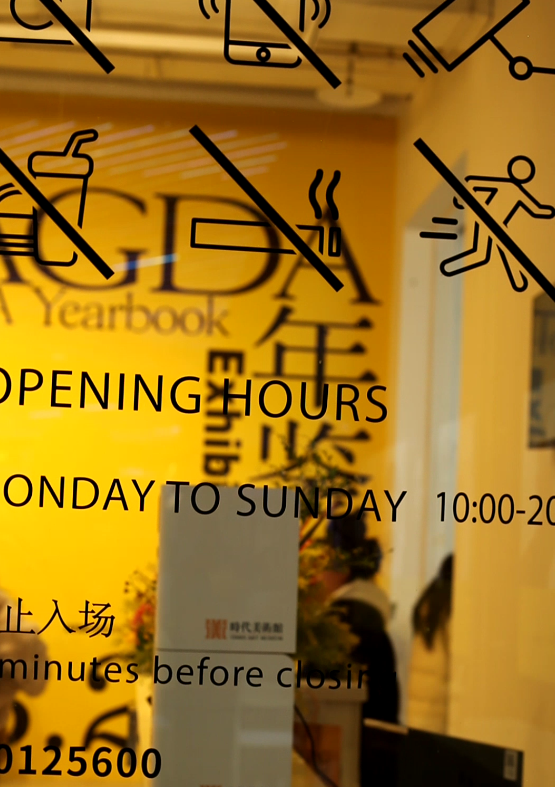
(Open daily, 10:00–20:00)
📍 Times Museum · Chengdu
Note: Ticket information is available through official channels.