A Visit to He Liping’s Studio in Siyi Village, Chengdu
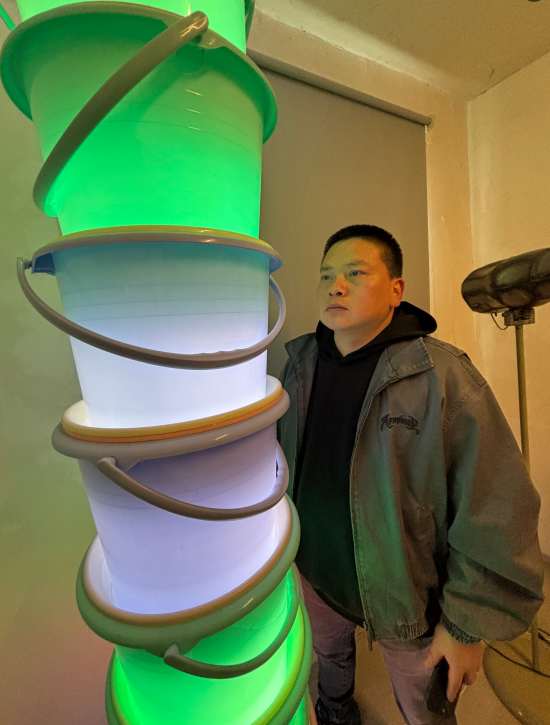
On the afternoon of March 4, we visited the studio of Chinese artist He Liping in Siyi Village, Xindu District, Chengdu. The visit is part of the ongoing artist documentation project “Qi Bi Fu – The Rhythm of Creation.”
Leaving the urban center of Chengdu, the road gradually leads into the outskirts where workshops, studios, and improvised spaces replace the familiar white-cube galleries of the city. Here, art unfolds in slower rhythms—amid dust, time, repetition, and everyday materials.
He Liping’s studio sits quietly within this rural environment. The space is neither polished nor theatrical; it resembles a workshop more than an exhibition space. Objects, tools, and fragments of past works accumulate naturally around the room, forming an environment where creation appears less like production and more like a long conversation with time.
“I Never Thought of Art as Something Mysterious”
During the conversation, He Liping repeatedly emphasized that his understanding of art has always been direct and grounded in everyday experience.
“I never thought art was something mysterious. It’s actually very simple. It’s about how you see the world.”
For him, artistic practice is less about constructing symbolic systems and more about maintaining a certain sensitivity toward ordinary reality.
“Art isn’t about showing how clever you are. It’s about whether you can remain honest.”
This perspective has shaped the tone of his work for decades—quiet, observational, and sometimes humorous.
“If There Is Sand in Your Heart, Anywhere Can Be the Maldives”
One of He Liping’s most widely known works is the 2015 performance piece “If There Is Sand in Your Heart, Anywhere Can Be the Maldives.”
In the work, the artist created a playful yet ironic situation: instead of traveling to the famous tropical paradise, he staged the idea of the Maldives through a simple symbolic gesture. The work questioned the cultural obsession with exotic landscapes and consumer fantasies.
Rather than presenting an elaborate spectacle, the piece relied on a conceptual twist.
“If there is sand in your heart, anywhere can be the Maldives.”
The sentence quickly circulated online and became associated with the artist’s name. Yet for He Liping, the work was never intended as a slogan—it was simply a reflection on perception.
The Maldives, in this context, is not a geographic destination but a mental condition.
The Studio as an Ongoing Process
Walking through the studio reveals a different aspect of He Liping’s practice. The environment is full of unfinished objects, experiments, and materials waiting to be reworked.
Unlike artists who emphasize the final form of artworks, He seems more interested in the continuity of making.
“Here there is no such thing as ‘finished.’ Everything is part of a process.”
Creation unfolds slowly, sometimes returning to earlier ideas years later. The studio itself becomes an archive of ongoing thoughts.
Beyond the Studio
During the conversation, He Liping also mentioned a new personal plan: he hopes to open a small wine bar in the future.
The idea is not unrelated to his artistic philosophy. For him, conversation, atmosphere, and informal gatherings are part of the broader ecology of culture.
A wine bar, in his imagination, could become another kind of social space—somewhere between a studio, a living room, and a meeting point for artists and friends.
Art Outside the White Cube
Visiting Siyi Village reminds us that contemporary art does not only exist in museums and galleries. Many artists continue to work in peripheral spaces where everyday life and artistic practice remain closely intertwined.
In He Liping’s case, the studio is not merely a workplace but a living environment where ideas grow gradually.
Creation here does not rush toward spectacle.
It moves in a quieter rhythm—
one stroke rising, another falling—
an ongoing dialogue between the artist and the world.