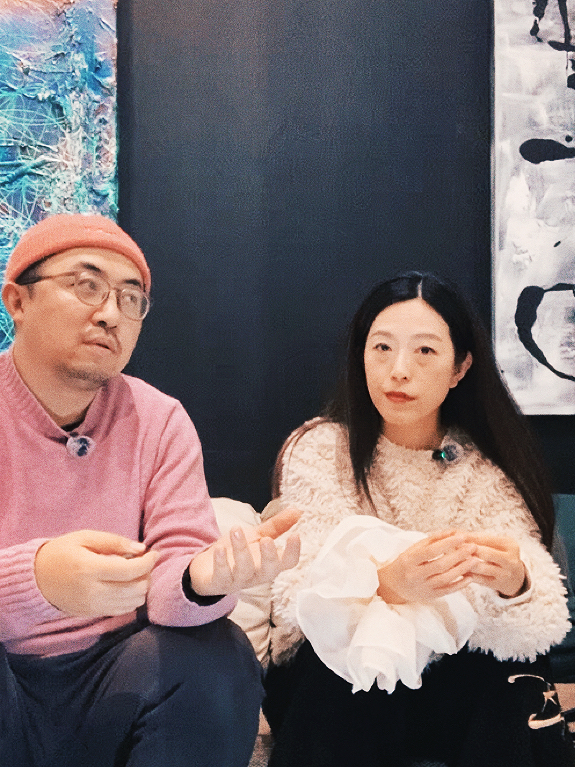
Tan Xiaozheng × Dong Jin
Time: Afternoon, December 31, 2025
Location: Xuliao Yuan Museum, 4th Chengdu Biennale, Second Floor Gallery
The last day of 2025.
The year had reached its end, while the new one had not yet truly begun.
The flow of visitors in the gallery was unhurried, as if time itself had slowed down.
At such a moment, we chose not to sit at a formal interview table. Instead, we settled onto a sofa on the second floor of the exhibition hall, letting the light and the rhythm of conversation guide us, speaking about thoughts that had not yet been summarized—and did not need to be concluded just yet.
One participant in the conversation was artist Dong Jin.
The other was Tan Xiaozheng, editor of BACKWALL and one of the founders of Dongke.
The two have known each other for fifteen years—from their first collaboration in 2010 on a poster for a Dongke industry event in Chengdu, to this reunion at the Biennale. Time, like a slow but steady line, connects Chinese animation aesthetics, contemporary art, self-media, and their respective personal paths.
I | Twenty Years of Committing to Something “Unmainstream”
Tan Xiaozheng’s question was direct:
In two decades of constantly shifting contemporary art trends, what has allowed Dong Jin to remain committed to animation aesthetics?
Dong recalls that her first official solo exhibition took place in 2013 at Beijing’s 798 Art District. The exhibition was nearly sold out, yet it also marked her first encounter with doubt—criticism that her work, filled with cartoon and animation elements, was “not contemporary enough.”
Rather than retreating, this skepticism pushed her to respond more forcefully in her second solo exhibition, attempting to confront the contemporary art system head-on. But when she returned to 798 a year and a half later, she found that many galleries had begun embracing cartoon imagery themselves.
“That was the moment I realized—what exactly had I been fighting against?” she said.
From initially aspiring to become a picture book illustrator, to experimenting with oil painting, ink, new media, and mixed materials under the guidance of her mentors, Dong gradually came to understand that materials and media should never limit artistic language. What truly matters is whether the artist knows what they are trying to say.
“If our artistic discourse is already in dialogue with the world,” she asked,
“why should animation aesthetics be excluded from contemporary art?”
II | Between Teaching and Creating, Always Being Pushed Forward
Unlike many full-time artists, Dong Jin has consistently maintained her role as a university educator. She does not see this as a constraint, but as a driving force.
She recalled being “temporarily assigned” to teach a Maya modeling course. In a short period of time, she had to learn, prepare, and demonstrate the material. Unexpectedly, that course became the starting point for the three-dimensional expansion of her personal IP—3D modeling, 3D printing, and physical production—eventually making her one of the earlier artists in China to enter the commercial IP licensing space.
“Looking back,” she said,
“I realize I’ve always been pushed forward by the university system.”
Self-media, meanwhile, became her primary channel for communicating with the world. As an introverted person, online platforms felt easier and more authentic than face-to-face interaction.
In her teaching, she consistently encourages students to publish their work and experiment with self-media. One student uploaded a single illustration and unexpectedly received thousands of likes—becoming a viral post.
“That was when I felt the true meaning of teaching,” she said.
III | Gen Z, Creative Freedom, and the Role of Our Generation
When speaking about Gen Z students, Dong’s tone softened noticeably.
She believes that as animation aesthetics gain broader acceptance, younger creators actually enjoy greater freedom. Unlike earlier generations, they no longer need to prove whether cartoons belong in contemporary art.
“Our generation’s role,” she said,
“is to connect upward to academic systems and continuously update ourselves downward. Young people just need to move forward bravely.”
This generational contrast has also made her more resolute in her 2025 work—allowing what she does best, and what brings her the most joy, to grow naturally.
“Maybe my next solo exhibition,” she reflected,
“will return to the purest and happiest state of creation.”
IV | When Art Becomes IP: Questions Beyond Aesthetics
When the discussion turned to IP and branding, Dong was notably clear-headed.
“An IP cannot be built by art or design alone—it’s a team effort.”
She emphasized that strong IPs require not only design, but also strategy and communication pathways. Many visually compelling projects fail commercially not because of aesthetics, but because they never clarify who the IP serves or what needs it addresses.
She shared her own approach: selecting concepts from a vast archive of personal IPs based on brand temperament and real-world demand, rather than pushing artistic expression in a single direction.
“What we offer,” she said,
“is not just an image, but a solution that can actually be implemented.”
V | Media, Exhaustion, and a Shift Toward Lightness
The conversation naturally turned to Tan Xiaozheng himself.
Over fifteen years, he has moved from animation industry media to art exhibition observation, and now toward lighter, more accessible content formats. He admitted that excessive professionalization in media can create distance between creators and audiences.
“If content becomes too professional,” he said,
“people stop daring to engage with it.”
Ahead of 2026, he launched a new brand, “Zhuan Jie” (Wandering the Streets)—using local urban life as an entry point, blending animation, art, cafés, bars, and city culture, and reaching a broader consumer audience.
As a friend, Dong spoke candidly: she hopes Tan can achieve financial sustainability.
“Artists,” she said,
“have to survive before they can talk about ideals.”
At the same time, she supports this shift toward lightness—bringing art back into everyday life and restoring a sense of “living presence” in content.
Epilogue | At the End Point, Looking Ahead
As the conversation drew to a close, visitors continued to move slowly through the gallery.
It was the last day of 2025. Looking back on the year—whether in artistic practice, teaching, media work, or personal life—fatigue, adjustment, and reorientation had been unavoidable.
Yet it was precisely at such a moment that clarity emerged.
Not every expression needs to be grand.
Not every path needs to be more professional.
Making things lighter, slowing the pace, and placing people back at the center of content and creation may, in fact, offer a path forward into the new year.
2026 had not yet unfolded, but its direction was already faintly visible.
It may no longer seek one definitive proof—
but instead resemble a road meant to be walked for a long time.
This is not an ending,
but a gentle shift of gears.