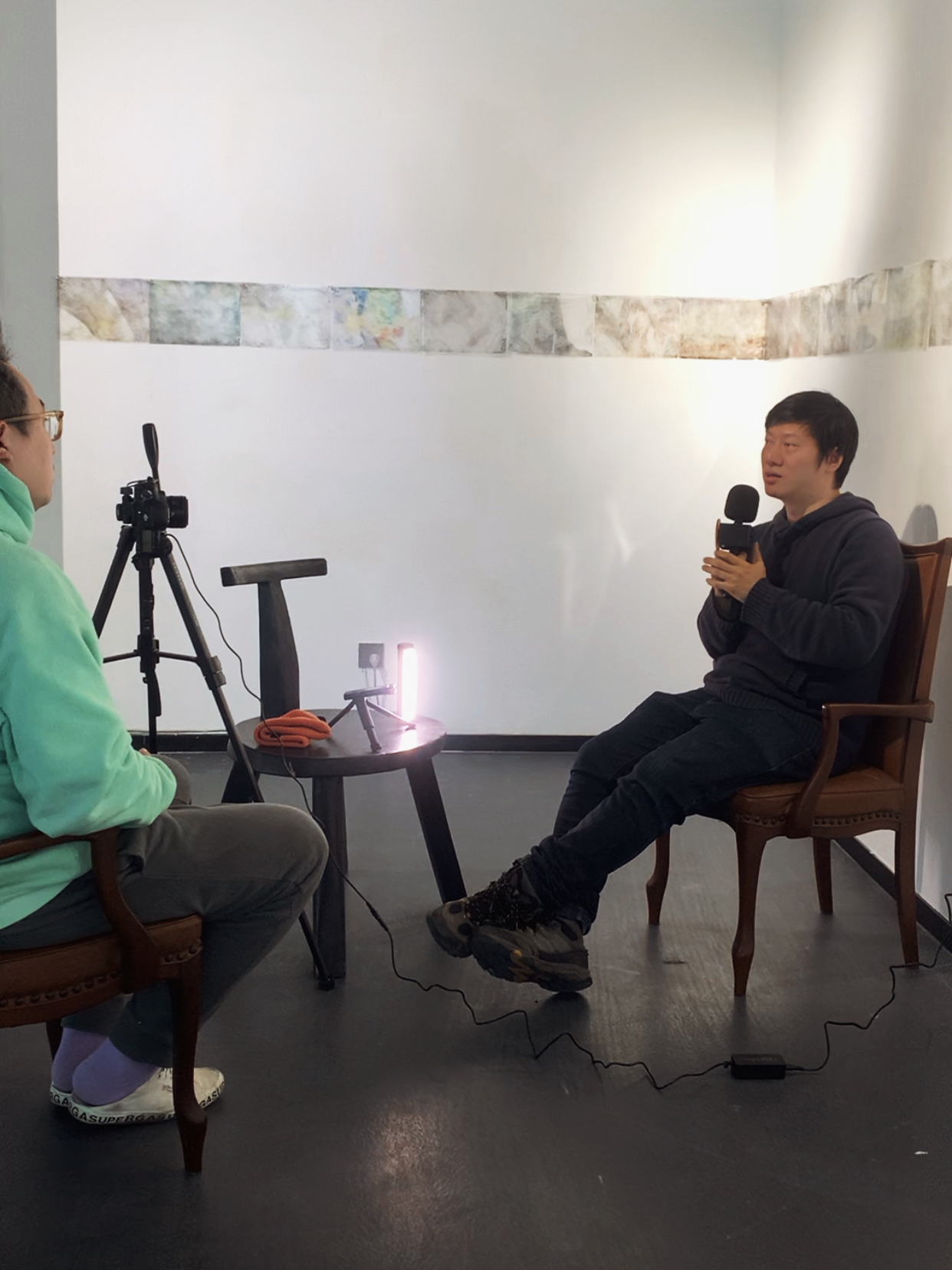
Shaoyan Yu never rushes to define himself.
At the beginning of the interview, he makes one thing clear first: “Let’s not make it too serious.”
He is not good at producing punchlines, nor is he interested in turning his practice into a grand statement. Instead, he prefers to start from lived experience—when he left, where he stayed, and how he slowly arrived at where he is now.
I. A Timeline: A Path Without Smooth Curves
Born in 1989 in Yichang, Hubei, Shaoyan Yu received rigorous training in traditional art at an early stage.
From 2007 to 2011, he studied calligraphy in the Chinese Painting Department at Hubei Institute of Fine Arts, a system rooted in brushwork, structure, and patience.
“I was trained in traditional art—calligraphy and painting. I’m very sensitive to materials and tactility.”
After graduation, instead of following an expected trajectory, he chose to leave.
In 2012, Yu moved to Germany, beginning an eight-year period of study and life abroad.
During this time, he first studied German, then shifted his focus to photography, completing both undergraduate and postgraduate studies in the field.
His education there did not emphasize a single stylistic direction, but rather continuous experimentation.
“During my undergraduate years, we learned everything—darkroom, film, portrait, documentary, even cinema. Every semester I took classes from different professors.”
This open structure gradually led him to a realization:
Photography was not merely image-making, but a medium that could enter the system of contemporary art.
“That’s when I knew I wanted to become a contemporary artist, not just a photographer.”
In 2020, after completing his postgraduate studies, he returned to China and began his own entrepreneurial path.
In 2021, he established Shaoyan Yu Art Studio in Shanghai.
The early years after returning were not easy.
“I was pretty lost at first. I spent two years as a freelance artist, attending events everywhere, with unstable income, constantly losing money.”
II. From Artist to Curator: A Turn Shaped by Reality
A real turning point came when Yu became deeply involved in exhibition operations.
For a period of time, he participated directly in the daily running of a gallery—handling everything from curatorial work to execution, from artist communication to on-site installation.
“That year, I did everything—curator, manager, even service staff. The whole gallery was basically run by me alone.”
It was not romantic, but it was decisive.
“That year changed my life. I realized that creation wasn’t the only thing I could do.”
From then on, his working method became clearer:
Alongside personal creation, he built a sustainable path through curating, exhibition organization, and art event production.
Today, he works simultaneously in three roles:
artist, curator, and art project organizer.
“I can’t give up being an artist, but I also need a way to survive.”
III. Time as a Continuing Core Theme
In Yu’s artistic practice, “time” is a recurring subject.
Yet it is not linear or narrative time, but something perceived, misremembered, and constantly altered.
In his recent exhibition The Cracks of Time in Chengdu, he experimented with a more abstract approach to image-making.
“I want to talk about the authenticity of images. What we remember may be real, or it may already have been altered by memory.”
The works unfold in layers:
documentation of the real world, material translation, and finally a “virtual image” that is little more than a shadow.
“When you realize you might be deceived—by others or even by your own memory—you start to question whether the world we live in is entirely real.”
For Yu, art does not resolve this doubt.
“I just present this state and let it remain there.”
IV. Neither Catering to the Audience Nor Avoiding Reality
Yu is fully aware that different spaces and cities receive works differently.
“If it’s a museum, I’ll explain things more clearly. In a composite space, I allow the work to be more experimental.”
He does not aim for universal readability.
“Simple documentation is fine, but I want to process images one more time. Once it becomes a conceptual image, what you shoot is no longer that important.”
This explains his constant movement between photography, materials, and installation.
What matters to him is how images are understood, not which medium they belong to.
V. Continuing to Work Within the Cracks
At the end of the interview, Yu does not speak of success or ultimate goals.
He talks instead about what remains to be done: new chapters, new exhibitions, new modes of collaboration.
“I’ll continue making new series and presenting them slowly through exhibitions.”
For him, art is not a final statement, but a long-term process of organizing one’s own experience.
The cracks will not disappear, and time will not stop.
All he can do is continue working within them.