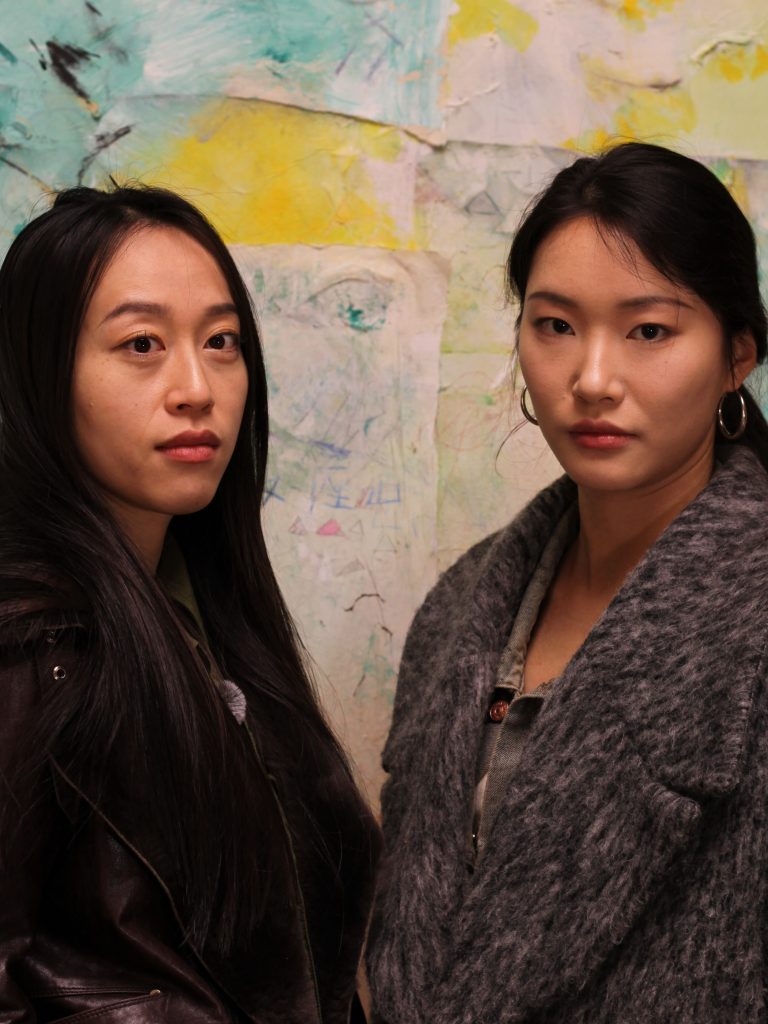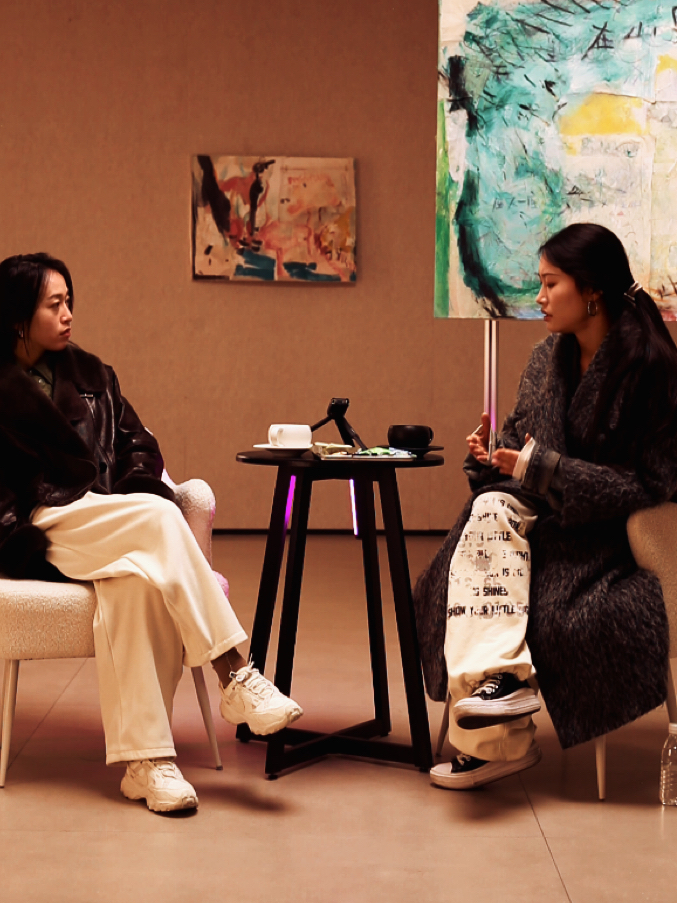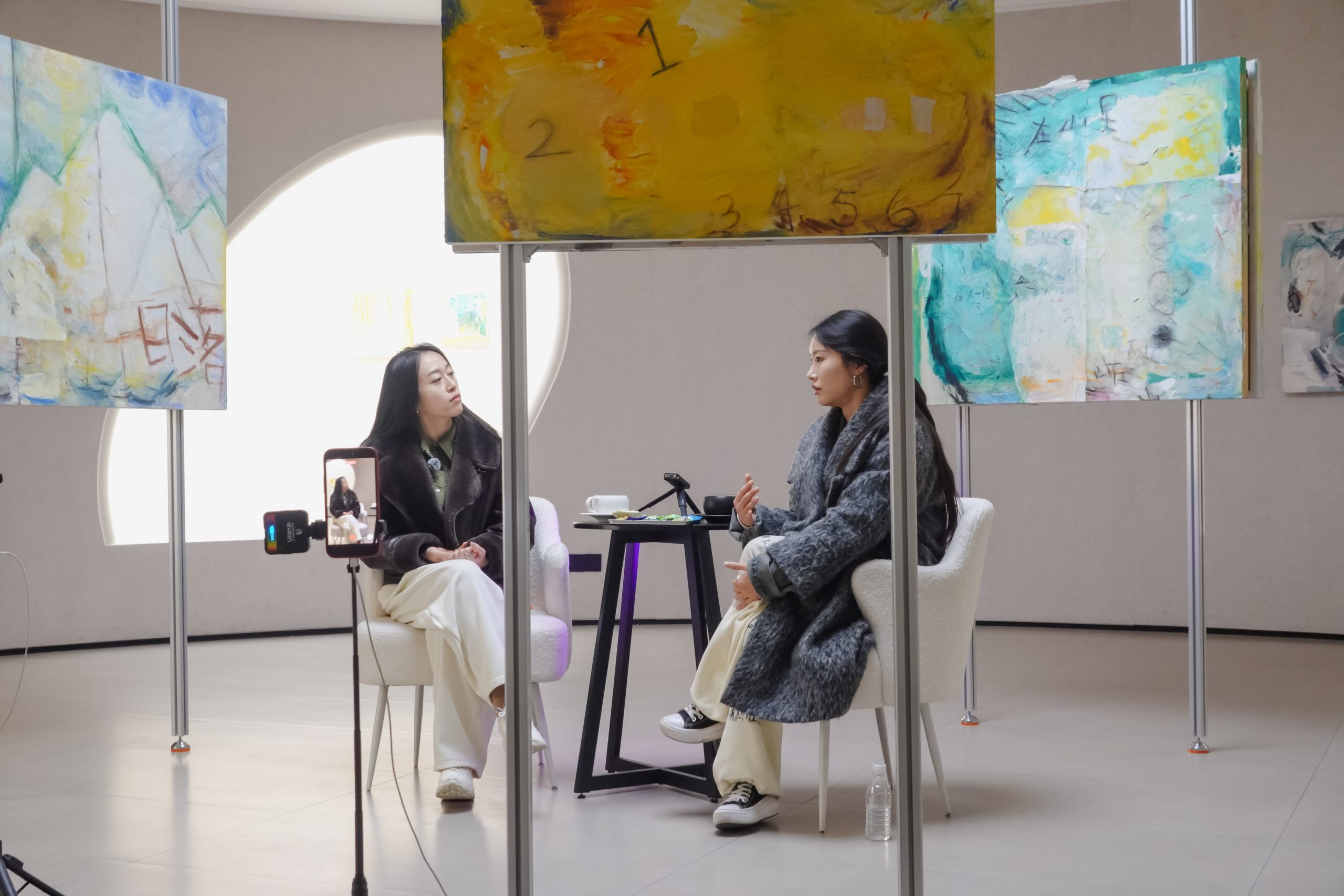
Date: January 29, 2026
Location: About Time Art Space, Chengdu
Exhibition: “Hey, Walk a Little Further In” — Jingli Gou Solo Exhibition
(Jan 11 – Mar 2, 2026)
This wasn’t a conversation designed in advance.
It felt more like an open working session—one that was allowed to happen.
The discussion didn’t always move forward in a straight line, and the speakers weren’t in a rush to reach conclusions. There were pauses, hesitations, moments of checking back: Did I really say what I meant?
BACKWALL chooses to document moments like these, rather than polish them into something smoother.
A Solo Exhibition Is Not Ambition — It’s Timing
For Jingli Gou, this was her first solo exhibition presented entirely as an individual.
Yet at the beginning of the conversation, she didn’t frame it as a “breakthrough” or a “milestone.” Instead, she described it with a calm sense of judgment: the body of work was ready, the phase had arrived, so the exhibition happened naturally.
The real pressure didn’t come from the work itself, but from what starts once an exhibition becomes a functioning system—catalog production, layouts, posters, communication, endless confirmations. These tasks aren’t creation, but they are very real parts of an artist’s daily labor.
After the exhibition opened, she didn’t rush into the next output. She chose to pause and process the feedback—both the positive and the critical. Over time, these responses settle, shaping what comes next.
It’s a rhythm that doesn’t hurry forward.
“Style” Is Not What She’s Concerned With
When the conversation turned to how artistic style is formed, Gou’s response resisted familiar narratives.
She doesn’t see style as something that needs to be deliberately constructed. For her, what people call “style” is simply what emerges naturally when she works from her own perspective, over time.
More than how to paint, she cares about what she is trying to say.
She wants to use language that feels as truthful as possible, to communicate the questions she’s genuinely thinking through—and to create a shared space of recognition with viewers. Not persuasion, but resonance.
This also explains the recurring use of text in her work. Words aren’t decorative; they step in when images alone can’t carry enough clarity. They become a necessary intervention.
An Exhibition as Training in Connection
As a curator and the founder of AVG Space, Kaili Shangguan consistently positioned herself as a companion rather than a judge throughout the conversation.
She wasn’t focused on evaluating how “complete” the work was. Instead, she spoke about exhibitions as public events—spaces where artists learn how to connect with the outside world.
In her view, an exhibition is a form of communication training. Feedback isn’t always gentle, but it exists—and it needs to be received, filtered, and understood.
She also made it clear that intermediaries in today’s art ecosystem are not redundant. Whether curators, agents, or art spaces, these roles aren’t meant to replace the artist’s voice, but to protect artists from being overextended and consumed.
Where Two Experiences Meet
What truly happened in this conversation wasn’t a clash of viewpoints, but a quiet alignment of experience.
One participant stands at the intersection between graduation and a necessary period of creative incubation; the other has long worked alongside young artists, paying close attention to psychological structures and systemic support. Their understanding of instability was remarkably similar.
Neither felt the need to prove anything quickly. Neither treated an exhibition as a final outcome, but rather as one node in a longer creative path.
This shared understanding wasn’t loudly declared—it surfaced naturally in the details of the exchange.
BACKWALL’s Position
As a documentarian, BACKWALL does not attempt to become the center of the conversation.
But its position is clear: a resistance to hollow art rhetoric, and a refusal to reduce artistic ecosystems to traffic metrics or commercial outcomes. The value of new media lies not only in monetization, but in long-term documentation, archival presence, and historical meaning.
Someday, when these materials are revisited, they may serve as important clues for understanding how creative practices took shape in this moment.
Unfinished Is the Most Honest State
This conversation did not produce definitive answers.
What it reveals instead is an ongoing condition—how one becomes oneself, and how patience is maintained within real-world systems.
Perhaps that’s exactly why it deserves to be recorded.
Coming Soon | A Series of Short Conversation Films
The full BACKWALL conversation is currently being edited into a series of short videos.
Through moving images, you’ll see details that text can’t fully capture: pauses, hesitations, moments of laughter—things that resist being turned into neat “key takeaways.”
This isn’t a set of summarized lessons, but a conversation still in progress.
The video series will be released on BACKWALL’s WeChat Video Channel and Xiaohongshu. Stay tuned.
If you care about how art is actually made in real conditions—not just how it’s discussed—this conversation may be worth continuing to watch.