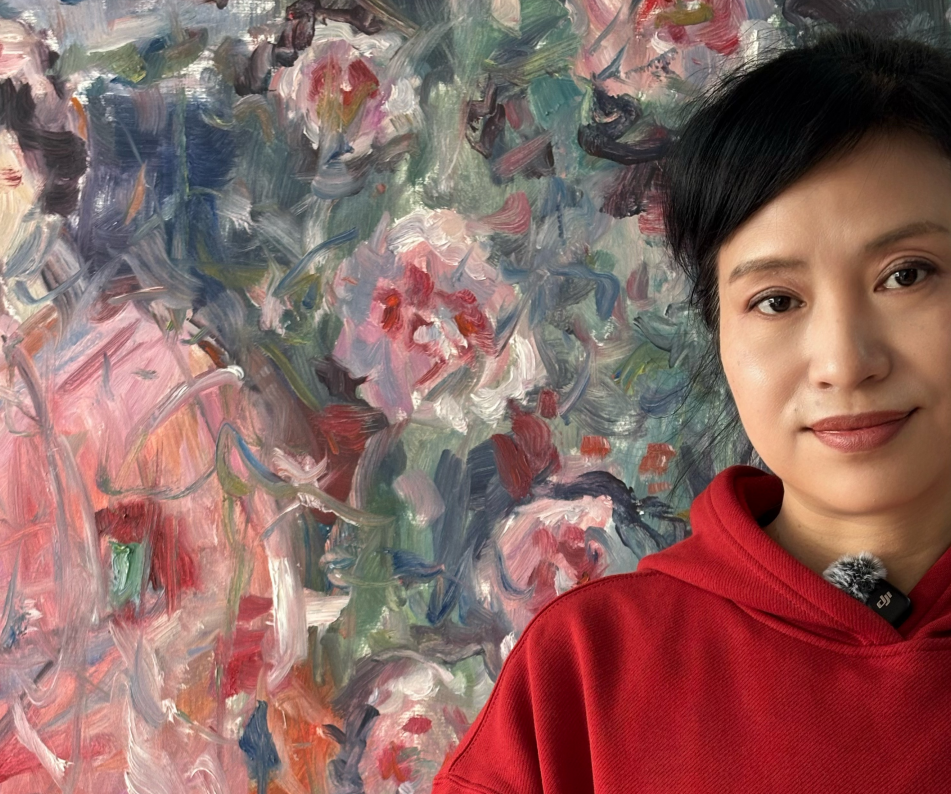
The conversation took place on a quiet afternoon on March 5, under a bright spring sun.
There was no formal interview structure—no prepared questions, no predetermined conclusions. We simply began by talking about her recent work, and the conversation unfolded slowly from there.
At times, it felt less like an interview and more like a shared moment of observation.
Meizi speaks in a measured rhythm. Her sentences often pause halfway, as if she is briefly testing whether the thought she is about to express truly belongs to the moment.
Those pauses become part of the conversation itself.
Born in Chongqing and raised in Chengdu, Meizi (You Yumei) originally trained in urban planning and architecture, graduating from Huazhong University of Science and Technology in 1990. For many years she worked at the Chengdu Urban Planning and Design Institute before leaving the profession in the late 1990s.
She did not begin painting seriously until 2015.
In another context, this might be considered a late entry into the field. Yet that distance from formal art training has shaped the character of her work. The architectural background remains visible in her sensitivity to line and spatial structure, but her paintings resist the discipline of precision.
Instead, they gravitate toward something less fixed—toward perception itself.
At one point during the conversation, she offered a simple observation about how we see other people.
“When we look at someone in conversation, we never really see them clearly,” she said.
“We’re not noticing the exact shape of their collar or their eyes.
What we perceive is more like a vague overall feeling—a kind of tone.”
For Meizi, painting begins from that condition of uncertainty.
Rather than reconstructing the world through detail, she is more interested in capturing a fleeting impression—a momentary emotional register that resists precise description.
Her working process reflects this approach.
Most of her paintings are completed in a single concentrated sitting.
“When I paint, I’m completely focused,” she explained.
“Usually I finish the whole painting in one go.”
There is little revision. The image emerges in a brief interval of attention, and once that concentration dissipates, the work ends.
This method gives the paintings a certain immediacy—an image that feels closer to a gesture than a construction.
In her early years of painting, many works carried a darker emotional tone. She spoke openly about the circumstances surrounding that period: social anxieties, personal pressures, and the long emotional weight of caring for a parent suffering from Alzheimer’s disease.
Painting became, in her words, “a way of releasing what couldn’t otherwise be expressed.”
Over time, however, the mood of the work shifted. Paintings gradually became quieter, lighter in tone.
The change was not intentional.
“It has a lot to do with how a person changes,” she said.
“Your way of looking at things changes too.”
At another moment in the conversation, she offered a line that seemed to capture the underlying logic of her practice:
“Sometimes blur is what makes the important things clearer.”
In a culture of image-making that often privileges precision, the statement feels quietly resistant.
For Meizi, clarity does not necessarily come from control. It may emerge from allowing uncertainty to remain visible.
Painting has also changed the way she observes the world.
She spoke about reading more literature and poetry in recent years, describing it as a form of slow self-education. Observation, reading, and painting gradually form a rhythm in her daily life.
More than anything, she seems interested in whether that process remains alive.
Not in defining herself as an artist, nor in fixing the meaning of the work, but in maintaining a certain sensitivity to experience.
As she put it during the conversation:
Painting is also a way of observing oneself.
How a line begins,
where it hesitates,
when it stops—
all of these gestures quietly reveal the person one is becoming.
The conversation ended without a formal conclusion.
It felt less like a finished interview than a moment in an ongoing process: a person still working, still thinking, still allowing uncertainty to remain part of the work.
And perhaps that openness is precisely where the work begins.
Artist: Meizi The conversation took place on a quiet afternoon on March 5, under a bright spring sun.
There was no formal interview structure—no prepared questions, no predetermined conclusions. We simply began by talking about her recent work, and the conversation unfolded slowly from there.
At times, it felt less like an interview and more like a shared moment of observation.
Meizi speaks in a measured rhythm. Her sentences often pause halfway, as if she is briefly testing whether the thought she is about to express truly belongs to the moment.
Those pauses become part of the conversation itself.
Born in Chongqing and raised in Chengdu, Meizi (You Yumei) originally trained in urban planning and architecture, graduating from Huazhong University of Science and Technology in 1990. For many years she worked at the Chengdu Urban Planning and Design Institute before leaving the profession in the late 1990s.
She did not begin painting seriously until 2015.
In another context, this might be considered a late entry into the field. Yet that distance from formal art training has shaped the character of her work. The architectural background remains visible in her sensitivity to line and spatial structure, but her paintings resist the discipline of precision.
Instead, they gravitate toward something less fixed—toward perception itself.
At one point during the conversation, she offered a simple observation about how we see other people.
“When we look at someone in conversation, we never really see them clearly,” she said.
“We’re not noticing the exact shape of their collar or their eyes.
What we perceive is more like a vague overall feeling—a kind of tone.”
For Meizi, painting begins from that condition of uncertainty.
Rather than reconstructing the world through detail, she is more interested in capturing a fleeting impression—a momentary emotional register that resists precise description.
Her working process reflects this approach.
Most of her paintings are completed in a single concentrated sitting.
“When I paint, I’m completely focused,” she explained.
“Usually I finish the whole painting in one go.”
There is little revision. The image emerges in a brief interval of attention, and once that concentration dissipates, the work ends.
This method gives the paintings a certain immediacy—an image that feels closer to a gesture than a construction.
In her early years of painting, many works carried a darker emotional tone. She spoke openly about the circumstances surrounding that period: social anxieties, personal pressures, and the long emotional weight of caring for a parent suffering from Alzheimer’s disease.
Painting became, in her words, “a way of releasing what couldn’t otherwise be expressed.”
Over time, however, the mood of the work shifted. Paintings gradually became quieter, lighter in tone.
The change was not intentional.
“It has a lot to do with how a person changes,” she said.
“Your way of looking at things changes too.”
At another moment in the conversation, she offered a line that seemed to capture the underlying logic of her practice:
“Sometimes blur is what makes the important things clearer.”
In a culture of image-making that often privileges precision, the statement feels quietly resistant.
For Meizi, clarity does not necessarily come from control. It may emerge from allowing uncertainty to remain visible.
Painting has also changed the way she observes the world.
She spoke about reading more literature and poetry in recent years, describing it as a form of slow self-education. Observation, reading, and painting gradually form a rhythm in her daily life.
More than anything, she seems interested in whether that process remains alive.
Not in defining herself as an artist, nor in fixing the meaning of the work, but in maintaining a certain sensitivity to experience.
As she put it during the conversation:
Painting is also a way of observing oneself.
How a line begins,
where it hesitates,
when it stops—
all of these gestures quietly reveal the person one is becoming.
The conversation ended without a formal conclusion.
It felt less like a finished interview than a moment in an ongoing process: a person still working, still thinking, still allowing uncertainty to remain part of the work.
And perhaps that openness is precisely where the work begins.
Artist: Meizi (You Yumei)
Interview recorded by: BACKWALL