Here is the professional English translation of your text, maintaining the academic rigor and the sophisticated tone suitable for an international art journal or curatorial archive.
Introduction
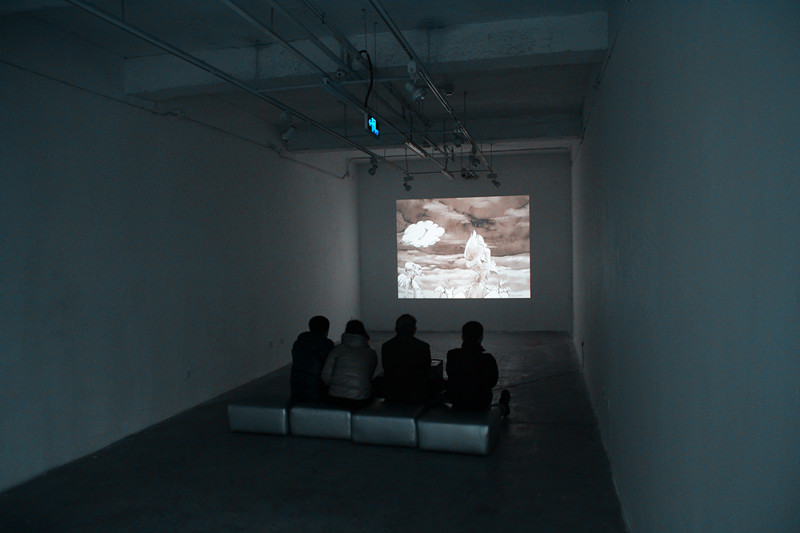
As I recently traced the ongoing trajectory of the “New Species IX” exhibition and the two-year longitudinal documentation of BACKWALL, my memory repeatedly converged upon a pivotal anchor: the “Animamix: Spiritual Clarity” (灵动清觉) animation exhibition, launched at the re-C (Covered Bridge) Art Space in Chengdu in 2011. At that time, this exhibition—characterized by an extremely restrained and low-profile posture—executed an experimental leap from an “industry closed-loop” to an institutional gallery setting.
Looking back, the foundation of this project was a “underlying protocol” constructed through seven years of industry research and professional accumulation by Dongkoh. It was a manifestation of full-spectrum industry trust, earned at the cost of time. Within a mere one-month slot, we mobilized the collaborative forces of almost all core animation departments in China’s leading fine arts academies. Such a curatorial practice—grounded in the “growth rhythm” of the discipline rather than the pursuit of transient discourse power—has nearly vanished in today’s fragmented media environment. This was not merely a screening; it was an independent empirical verification of “animation as contemporary art intervening in space.” It disdained the hollow label of “Independent Animation,” choosing instead to stand firmly upon common sense to reconstruct the ontological value of animation creation.
Main Body: Collective Resonance: Re-evaluating the 2011 “Animamix” as a Landmark of Collaborative Ecology
In the early winter of 2011, a strategically ambitious “collaboration” took place at the re-C (Covered Bridge) Art Space in Chengdu. At a time when global animation discourse was trapped between the hyper-commercialism of Hollywood and the isolated “Auteurism” of independent festivals, the “Animamix: Spiritual Clarity (2011)” exhibition offered a radical alternative: a month-long social art experiment that bypassed individual heroism in favor of a “Collaborative Ecology.”
The “Middleware” Strategy: Transcending Institutional Boundaries
Co-organized by Dongkoh and the China Intercontinental Communication Center (CICC), this exhibition was far more than a mere showcase; it was the physical manifestation of a seven-year longitudinal study.
Since its founding in 2004, the professional media platform Dongkoh, operated by curator Tan Xiaozheng, acted as a “Cultural Middleware.” Through a massive investigative project initiated in 2006—comprising field interviews across national academies and enterprises—the curatorial team established a “Trust Infrastructure” rarely seen in contemporary curating. This facilitated an unprecedented academic convergence on a horizontal dimension among China’s elite art institutions, including the Central Academy of Fine Arts (CAFA), the China Academy of Art (CAA), and Tsinghua University.
“This exhibition is a channel to truly understand the Chinese animation industry… it is not hypocritical, not exaggerated, but a sincere reflection of our reality.” — Tan Xiaozheng, 2011.
(Image: 2011 Event Site)
From Auteur to Assemblage: The Dissolution of Individual Heroism
While the international art market often obsesses over the “Genius” narrative, Animamix executed a “De-labeling” strategy. It deliberately ignored the then-trendy “Independent Animation” tag, opting instead to present works horizontally as “Animation Shorts” without hierarchical distinction.
This “De-heroized” approach shifted the focus toward the Pedagogical Pulse:
- Mentor-Student Synergy: By emphasizing institutional guidance alongside student teamwork, the exhibition defined animation as an “Assemblage”—a collective output generated by the intersection of social, technical, and academic forces.
- The Rhythm of Growth: The exhibition respected the “natural maturation” of the animation discipline, treating the results of the first decade of formal academic evolution (2000–2010) as a “Living Archive” rather than a trophy room for static display.
A Global Lens on Local Verticals
From an international perspective, Animamix (2011) anticipated the global shift toward “Research-based Curating.” The partnership with CICC provided a “Global Megaphone,” translating local academic rigor into a universal language of creative potential.
This was not just about the aesthetics of moving images; it was about the “Recording of People” (Reading People > Reading Works). This philosophy continues to drive the curator’s current projects, such as BACKWALL, treating the exhibition space as a “Dynamic Dossier” that records human presence within the digital medium.
(Image: 2011 Exhibition Site)
Legacy: An Archive for the Future
Fifteen years later, Animamix (2011) stands as a testament to “Long-termism” in an era of rapid-fire consumption. It reminds the international art community that the most resilient creative ecosystems are not built on hype, but on field research, professional integrity, and a profound respect for the slow, organic growth of a discipline.
Within the lineage of Chinese contemporary image and animation art, Animamix remains a pivotal anchor—a moment where the industry’s “nervous system” was mapped out, ensuring that the history of Chinese animation is told not just through its films, but through the collective heartbeat of its creators.
Keywords: Collaborative Art, Institutional Critique, Research-based Curating, Dongkoh, Animamix 2011, Chinese Contemporary Animation.