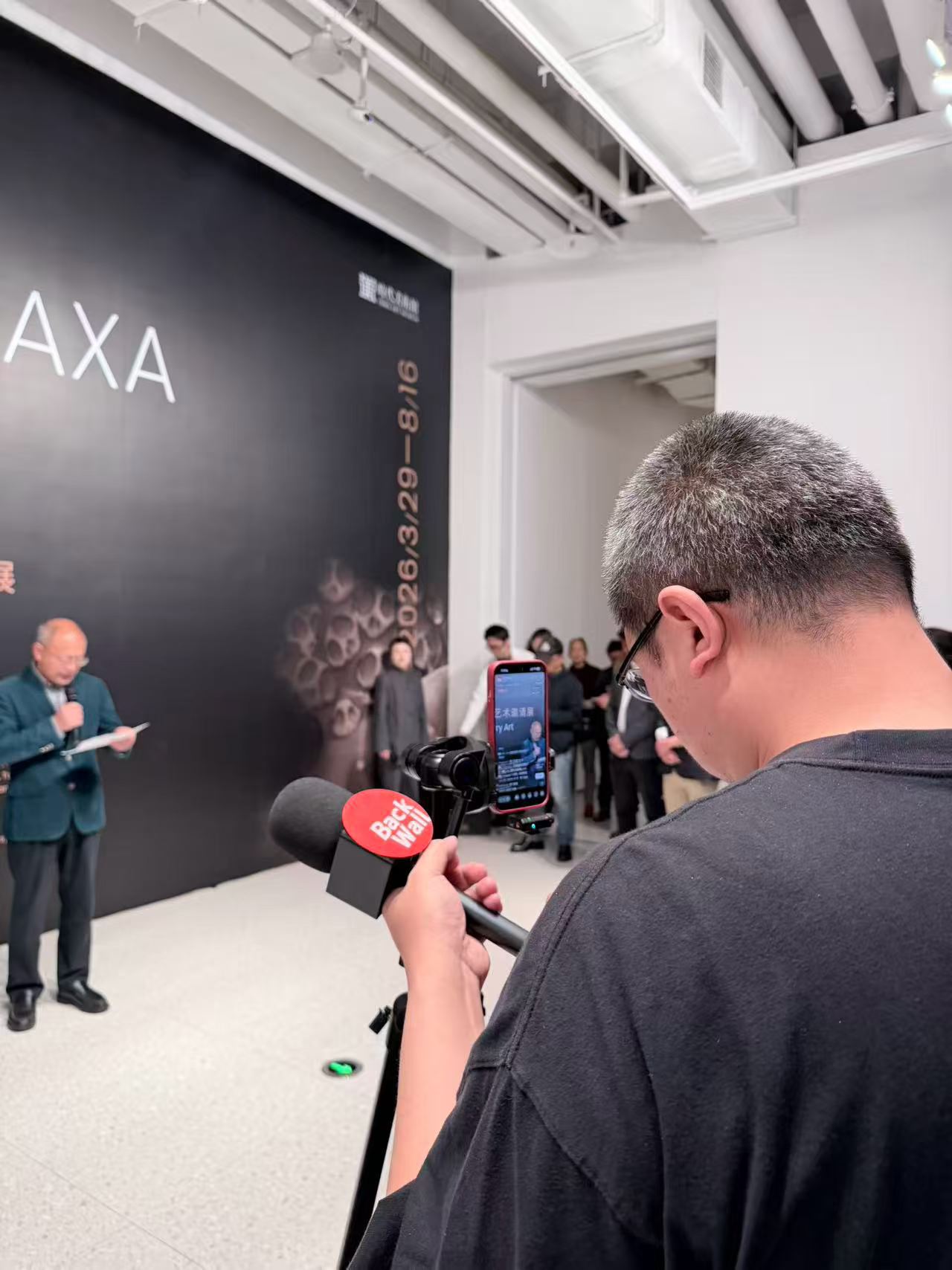
Within the contemporary condition where art and digital media are deeply entangled, BACKWALL’s thirty-month trajectory (September 2023 – March 2026) constitutes a case worthy of serious consideration. It is neither a traditional art publication nor fully aligned with the logic of content production. More precisely, BACKWALL should be understood as an experiment addressing a fundamental question:
Can media still serve as a vessel for lived, real experience?
From an international perspective, this project aligns more closely with a method-based artistic practice—one that prioritizes neither distribution efficiency nor visibility, but instead asks whether media can once again function as an extension of the site of life itself.
I. BACKWALL as Method: From “Reading Works” to “Reading People”
The foundational methodological shift of BACKWALL lies in its proposition: reading people is more important than reading artworks.
In contrast to established art publications such as ArtReview or Artforum—which operate through structured critical discourse, interpreting and assigning value to artworks—BACKWALL adopts a fundamentally different approach:
- Shifting attention from artworks to individuals
- Moving from outcomes to processes
- Transforming writing from conclusion to ongoing generation
Its programs, such as Post-Voice as Awe and From Stroke to Stroke, are not merely interviews or reports. Rather, they resemble anthropological participant observation—a sustained engagement through conversation, presence, and documentation that builds a dynamic understanding of artistic subjects.
In an international framework, this approach resonates with:
- De-institutionalized forms of critique
- Artistic fieldwork centered on lived experience
Thus, BACKWALL’s early phase was essentially an attempt to construct a non-capital-dependent system of professional trust—one built not on institutional authority, but on sustained presence and high-density documentation.
II. From Documentation to Intervention: Virtual Curating and the Shift of Media Power
By 2025, BACKWALL underwent a decisive transformation:
it moved from documenting art to intervening in art.
Programs such as Exhibitions Without End and Three Scenes Four Acts, alongside live-stream practices, introduced a form of “mobile site.” This shift implies:
Media no longer merely reflects art—it begins to participate in its production.
This trajectory culminated in its online exhibition projects PASS and ZHUA. At this stage, BACKWALL was no longer a content producer but a trigger of rules:
- Lowering barriers to participation through digital means
- Generating discursive density via high-frequency output
- Challenging entrenched logics of capital and institutional inertia
Such strategies are not unfamiliar in global contemporary art, where media itself often becomes a curatorial tool. However, what distinguishes BACKWALL is that:
It did not emerge from within the art system, but rather infiltrated curatorial logic from the structure of self-media.
In other words, it was not an extension of institutional power, but an experiment in reversing the direction of media agency.
III. Structural Rupture: The Limits of Decentralized Practice
Yet the very methodological innovation of BACKWALL also determined its structural limitations.
Despite the intensity and immediacy of its output, it lacked:
- A stable knowledge structure (indexable and accumulative texts)
- A coherent editorial framework (logical integration across programs)
- A translatable academic language (an interface for global discourse)
As a result, BACKWALL remained in a state of high production, low sedimentation.
In international comparison, this reflects a common dilemma among independent art media:
the rejection of centralized structures often comes at the cost of knowledge production capacity.
Thus, while BACKWALL generated a significant volume of material, it has yet to fully transform into:
- An archive
- A body of research material
- Or a critical system
It remains closer to an ongoing process than a stable, citable text.
IV. Cultural Tension: Documenting an Opaque System
The conclusion of BACKWALL cannot be reduced to individual fatigue; it must be situated within a broader cultural framework.
Its notion of charitable fatigue reveals a deeper contradiction:
Within an art ecosystem structured by relationships and selective visibility,
sustained open documentation ultimately exhausts the documentarian.
In such a system:
- Likes become social transactions
- Shares become expressions of alignment
- Content value is diluted by relational dynamics
BACKWALL’s insistence on non-utilitarian documentation thus enters a paradox:
The closer it moves toward truth, the less it can be effectively absorbed by the system.
This condition echoes marginal practices globally, where independent media—refusing alignment with capital or institutions—often becomes intermittent or short-lived.
V. Withdrawal as Method: The Meaning of Suspension
BACKWALL’s planned suspension in March 2026 should not be understood as failure, but as a methodological withdrawal.
This withdrawal carries three implications:
- A refusal of platform logic
Rejecting a system driven by traffic metrics and unpaid labor - A preservation of subjectivity
Interrupting production before its value is fully diluted - An archival closure
Framing thirty months of activity as a complete temporal unit
In media theory and art history, such acts of cessation can themselves be read as statements:
media does not have to persist indefinitely—to stop is also to articulate.
VI. As Archive and Symptom: The Long-Term Value of BACKWALL
Over a longer temporal horizon, BACKWALL’s significance lies less in its reach than in its dual function:
1. Informal Archive
It documents:
- The operations of small-scale art spaces
- The linguistic and expressive states of emerging artists
- The atmosphere of the mid-2020s art ecosystem
Such materials may become valuable resources for future research.
2. Cultural Symptom
It exposes:
- The friction between artistic content and platform mechanisms
- The tension between independent individuals and relational networks
- The scarcity of critical space in contemporary art discourse
In this sense, BACKWALL is not only a recorder but also an object of observation—
a case study of its own time.
Conclusion: The Limits of Media and the Position of the Individual
Looking back on these thirty months, one question remains central:
In a reality shaped by algorithms, capital, and social relations,
can individual media still carry truth?
BACKWALL offers an answer that is not optimistic, but precise:
- Truth can be constructed temporarily
- Trust can be generated locally
- But neither can be sustained indefinitely
Thus, the end of BACKWALL is not merely the disappearance of a project, but the manifestation of a condition.
It demonstrates that:
Even within highly structured systems, individuals can still construct, through persistence in common sense and presence, a temporary yet real island of professionalism.
And the very existence of such an island constitutes one of the most direct—and honest—responses to the contemporary art ecosystem.