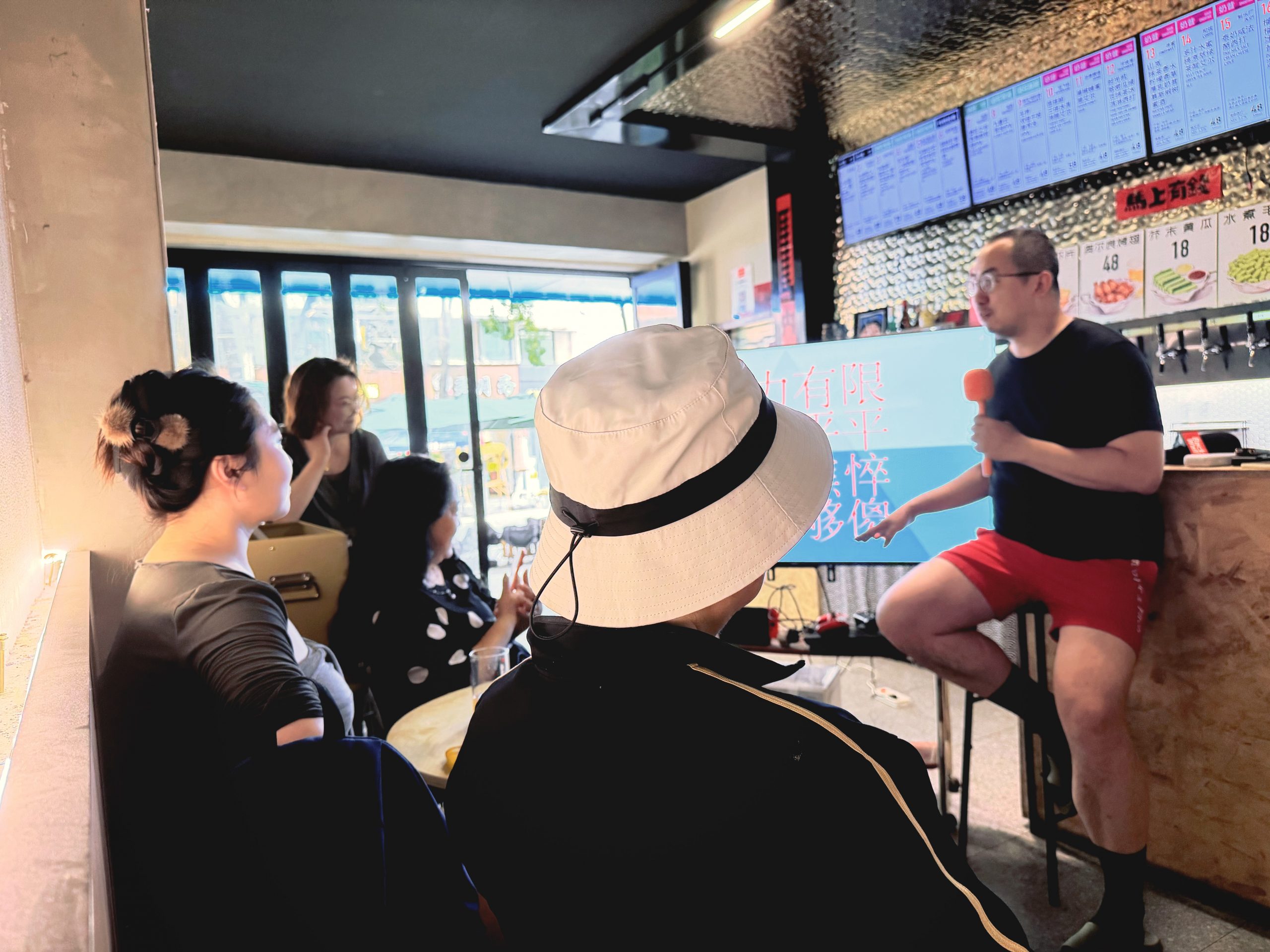
Planet Brewery sits on the corner of Yulin West Road.
People trickled in after two in the afternoon. No welcome committee, no sign-in desk. Tan Xiaozheng stood by the door in a pair of slippers, checking tickets, asking people how they got here as an afterthought.
Some drove. Some took the subway. He nodded. Said, find a seat inside.
It was muggy that day in Chengdu, but he hadn’t turned on the air conditioning. The windows were open instead, letting the breeze in — along with the muffled hum of traffic from the street.
Five to three, he half-closed the windows.
The event began.
About This Observation
One thing first: I run a subjective reporting outlet. I’m not here to transcribe what he said. I’m here to watch him.
So what’s follows is not an event recap. It’s my judgment.
What He Said — Worth Believing
“Ninety-nine point nine percent of all ‘super-individual’ rhetoric online is nonsense.”
I believe this.
Not because it’s particularly profound — but because he says it with the kind of conviction that only comes from having lived it. He’s genuinely been at this for 22 years. Started a company, stayed in a psychiatric hospital, deregistered the company. None of that can be faked online.
Laying your first half-life bare for strangers, without packaging, without sentiment, without self-pity — and still willing to say “what you’re reading online is garbage.”
That’s not arrogance. That’s evidence.
The Seconds After Depression
“In 2016 I fell into depression and was hospitalized.”
He said this while discussing the cost of working alone.
After the sentence, he moved on. Same tone. Same rhythm. As if nothing had been said.
But for those few seconds, the room went quiet.
No one took photos. No one shifted. No one exchanged glances with the person next to them.
Quiet enough to hear a car pass on the street outside.
What I wondered: after he said that, did anyone actually message him privately?
My guess: some did. Not many.
Chinese society’s understanding of depression is still stuck at “just think more positively.” He spoke lightly; the room listened carefully. Nobody knew what to say.
This was the most real moment of the whole event. And the most unsolvable one.
What He Said — Worth Questioning
“Growth comes before survival.”
The most counter-intuitive thing he said all afternoon. Every entrepreneur has heard “survive first, grow later.” He tore that down directly.
My take: he’s half right.
He’s right that survival-mode traps you in low-value work and erodes your sense of direction.
He’s questionable on the conditions. Tell that to someone with aging parents, a mortgage, dwindling savings, and a kid to feed — and it’s deeply irresponsible.
He did add later that he’s a “mission-driven entrepreneur,” doing this one thing for a lifetime. That’s valid — but not a blueprint for everyone.
His path took 22 years to validate. The cost of that validation isn’t something anyone can afford to copy.
The Three Times He Walked Away
He mentioned passing on three opportunities to be “co-opted” — a state-owned enterprise, a large company, an acquisition offer.
Sounds cool.
My question: when did each happen? What were the terms? What did the years after look like?
Walking away in his first three years of bootstrapping isn’t a choice — it’s having no choice. If the price was a decade of scraping by, it’s not courage, it’s a bet.
“I still had something I needed to do.” Sounds principled. But how a person defines “what needs to be done” is exactly the kind of thing worth interrogating.
He didn’t give anyone the chance.
What He Didn’t Say
About income — not a single number the whole afternoon.
Not that he should be flashing cash. But: after 22 years, how is he actually living?
An apartment? Savings? What happens when he’s sick? When he’s old?
How many people in that room had the nerve to ask?
My guess: close to zero.
About his clients — he said he does brand PR execution work. But who are they? How did they find him? Why him over anyone else?
What did 22 years actually accumulate into?
He sidestepped this.
About the Event Itself
20 people, 50 yuan ticket, one craft beer, three hours.
From what I saw: most attendees were between 25 and 35. Designers, independent media people, people seriously considering quitting their jobs to do something of their own.
In other words: people who, like the young Tan Xiaozheng, were in the crack — wanting to build something, not sure it would work, lonely, directionless.
That’s a good thing.
But I also noticed: nobody there was “already successful.”
What does that tell you?
His story resonates with people already on the path. For those still deciding whether to start, it’s a bowl of chili-spiced chicken soup — not bad, but not for everyone.
My Judgment
Is what he said worth hearing?
Yes. Not because he’s right — because he’s honest.
22 years of experience, honest. The pits he fell into, honest. Depression, honest. The ambivalence of every choice he walked away from, probably honest too.
No success mythology, no promises, no “follow me and you’ll get here too.”
On that basis alone, he’s already ahead of 90% of the entrepreneurship gurus online.
As for the debatable parts?
That’s a conversation for another day.
He’s been at this since 2004.
The slippers have seen many pairs over the years.
Everything else, it seems, hasn’t changed much.
BACKWALL — Subjective Media, Critically Observed