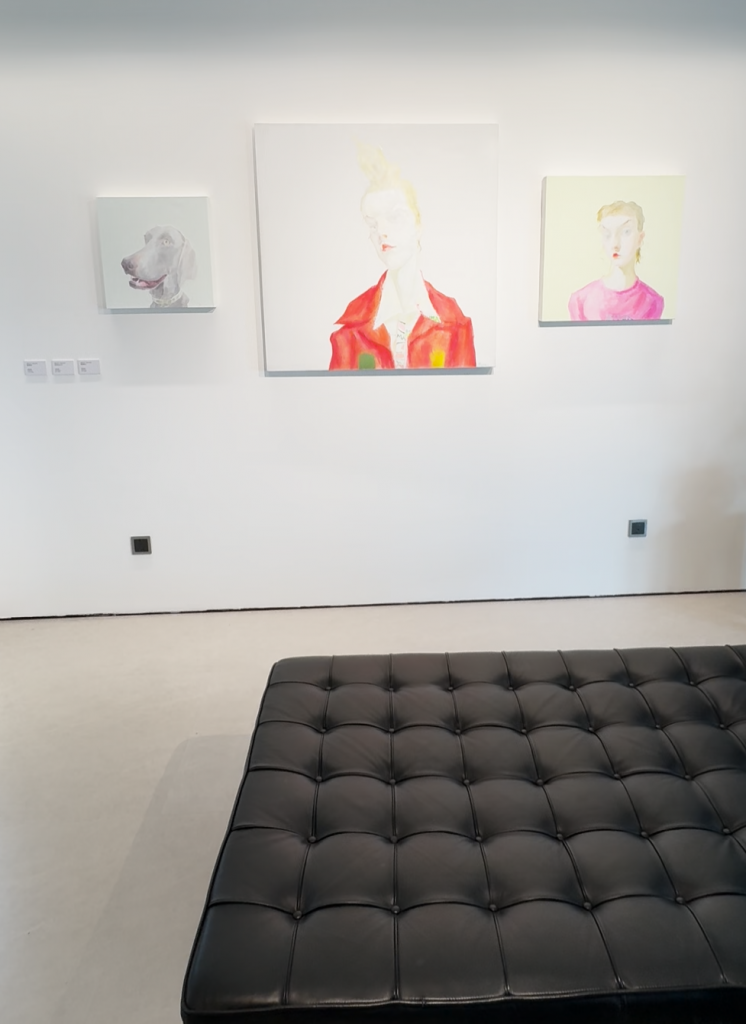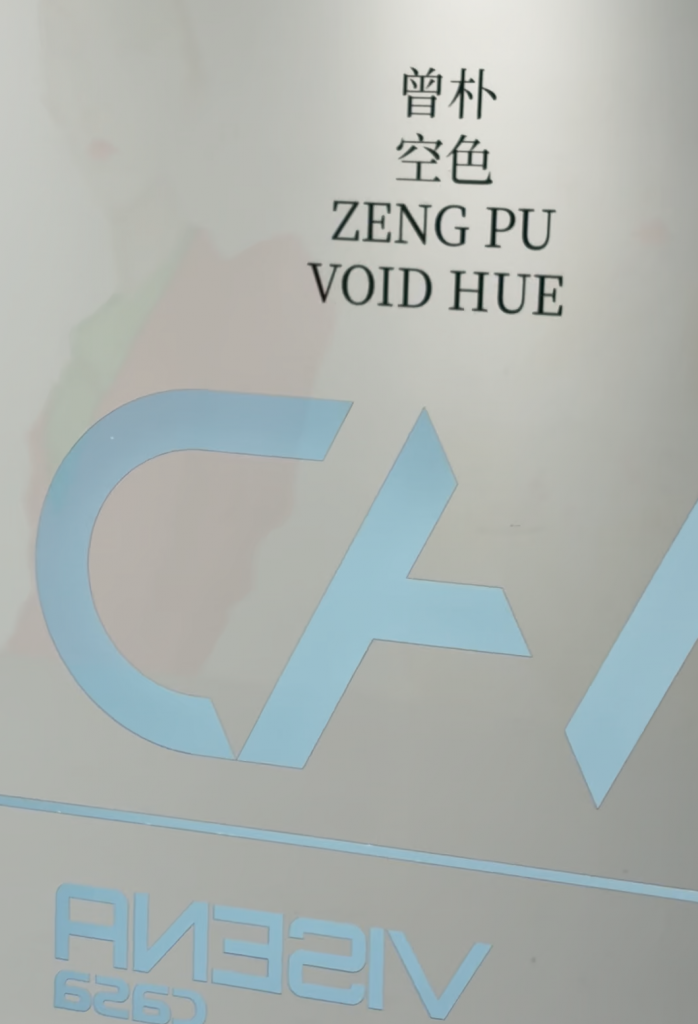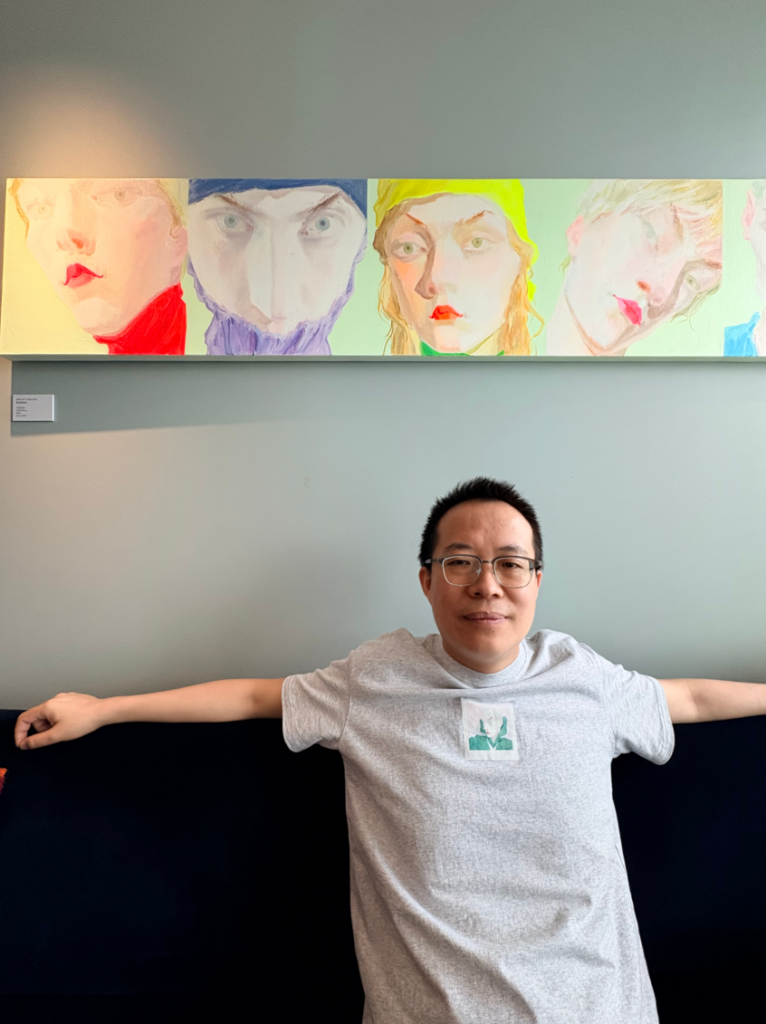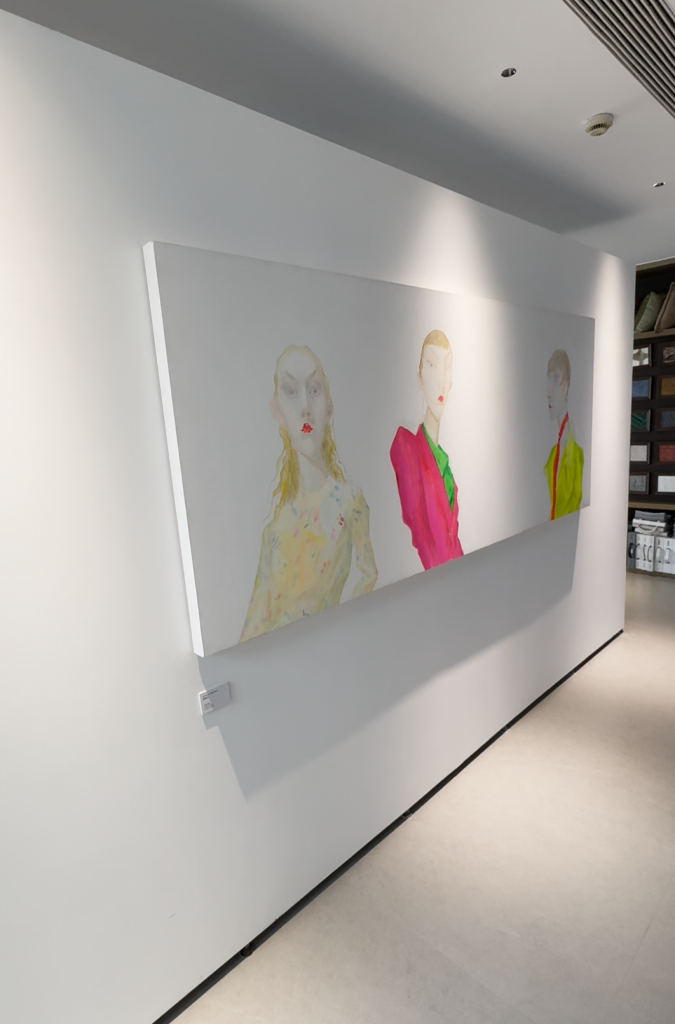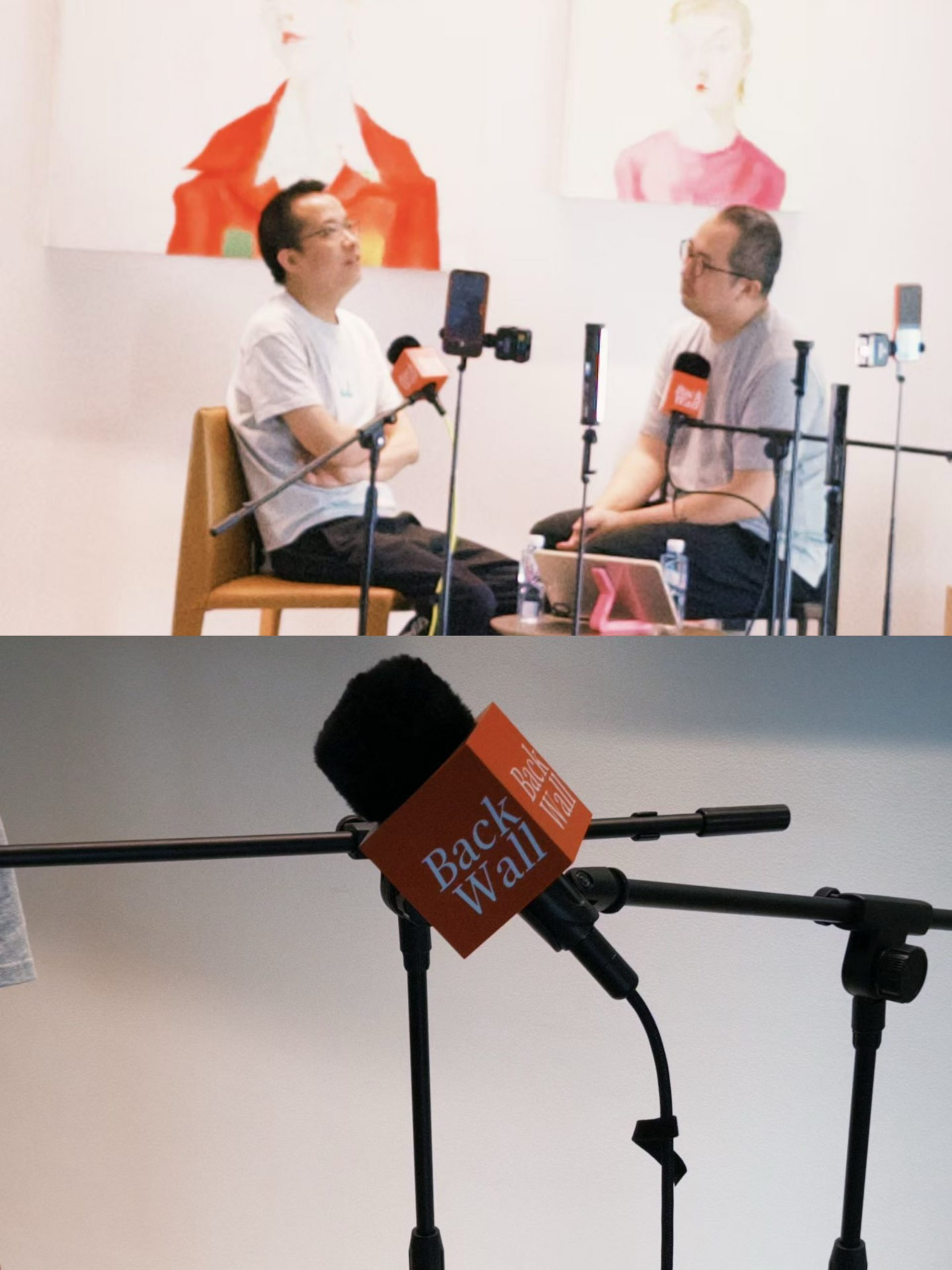
On the morning of July 4, Backwall recorded a video podcast inside Zeng Pu’s recent solo project, Sky Color, at the exhibition space of VAD Weishun’an Design Office.
The setting matters.
This was not a typical white-cube gallery or museum space. It was a design office, a place closer to everyday work, conversations, meetings, and urban life. That context shaped the whole conversation: what happens when painting steps outside the gallery system and enters a more lived-in space?
For about an hour, Backwall editor Tan Xiaozheng sat down with artist Zeng Pu to talk about his career, Chengdu’s art scene, painting, art history, public images, AI, galleries, and what it means when ordinary viewers say, “I don’t get contemporary art.”
This conversation is not just about who Zeng Pu is.
It asks a bigger question:
In a world shaped by global art systems, endless digital images, and local art communities, how does a painter keep painting?
1. Locality Is Not the Same as Being on the Margins
Zeng Pu’s path does not follow the usual “leave the local scene and move toward the center” story we often hear in Chinese contemporary art.
He came from Xichang, studied and worked in Chengdu, once set up a studio in Shanghai, and eventually shifted his focus back to Chengdu. When he looks back on more than twenty years of making art, he describes it in a simple phrase: painful, but joyful.
That phrase is not romantic. It feels honest.
Zeng Pu does not present his career as a heroic story. Instead, he talks about it as something long-term, everyday, and real. There has been pressure. There has been uncertainty. There have also been lucky moments, unexpected encounters, and a steady commitment to painting.
That is the best entry point into his work.
In the global art world, “local” is often misunderstood as “outside the center.” But for Zeng Pu, Chengdu is not just a background or a fallback option. It is a working condition. It gives him a slower rhythm, a looser social environment, and a daily structure that allows him to keep painting.
During the conversation, Zeng Pu admitted that Shanghai has a more mature art ecosystem. M50 and other art districts developed earlier; galleries, collectors, foreign art professionals, and art consumption habits all became part of that system. Chengdu, by comparison, still has a long way to go in terms of collecting and market maturity.
But he does not treat Shanghai as the only valid destination.
For him, today’s transportation and digital networks have already changed the old center-versus-periphery logic. An artist no longer has to stay permanently in one art capital to stay connected. What matters more is whether the work can keep moving forward.
That is why Zeng Pu’s decision to stay in Chengdu is not a retreat. It is not nostalgia, either.
It is a clear choice about how to live and how to work.
For a mid-career artist, life is not just about exhibitions and studios. Family, aging parents, daily schedules, physical energy, friendships, and time for work all become part of the creative condition. An artist’s “position” is not only geographic. It is also about how one organizes time, life, and attention.
In that sense, Zeng Pu is not waiting in Chengdu to be seen by the center.
He is building his own position from Chengdu.
2. From Private Portraits to Public Images
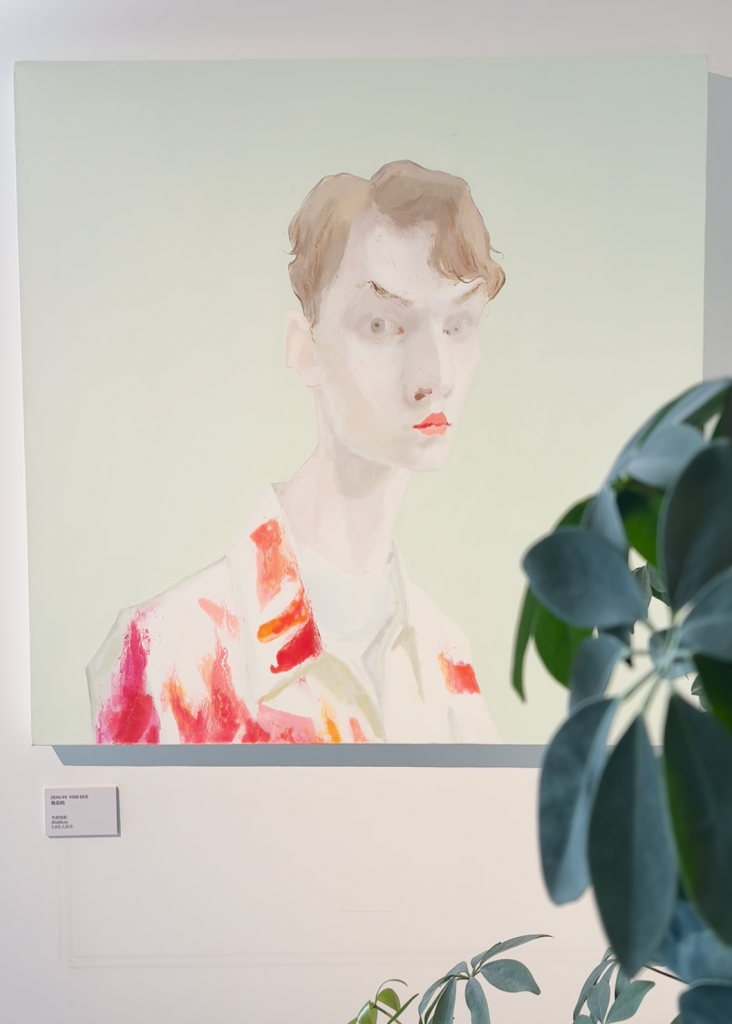
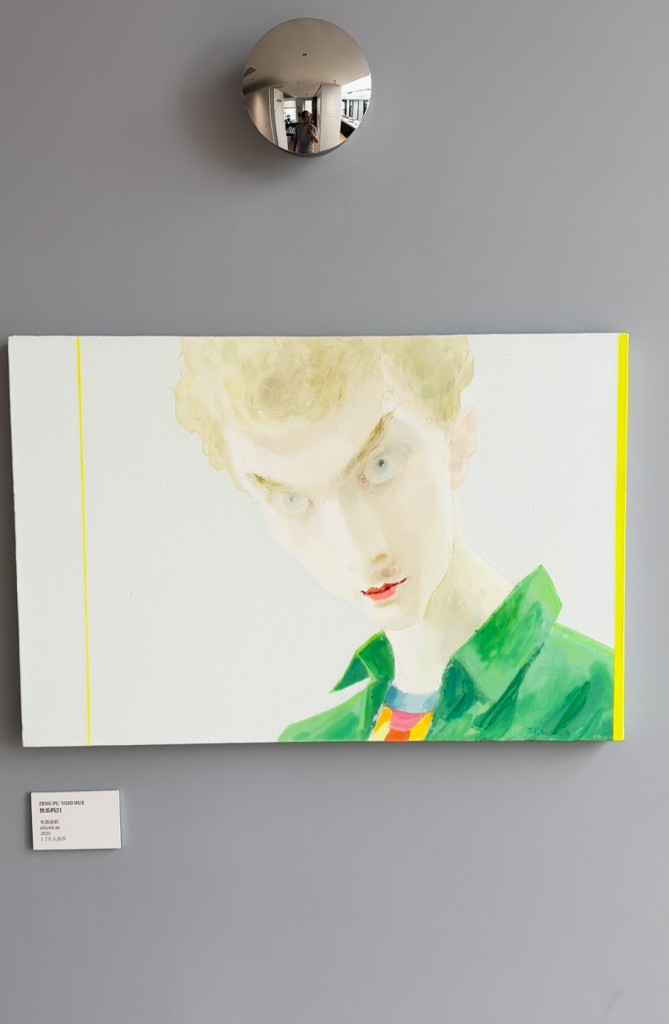
The most recognizable subject in Zeng Pu’s paintings is the human figure.
But these are not portraits in the traditional sense. They do not try to capture a specific person’s identity, personality, or social background in a realistic way. They also do not function like fast-consumed faces from pop culture.
They feel more like faces filtered through the global image system: light, ambiguous, and shaped by fashion magazines, film stills, online photos, personal memory, and contemporary emotion.
When Zeng Pu talks about his earlier “Heart” series, he describes those works as snapshots of a moment. They came from quick feelings, instant observations, and small emotional flashes. The paintings were often small in size and made with a sense of speed and ease. Later, he added more background, color blocks, and lines, and the work slowly developed into later series such as “Are You Happy?”
One of the most interesting moments in the interview comes when Tan Xiaozheng asks why many of the faces in Zeng Pu’s paintings seem to look European or Western.
Zeng Pu’s answer is important: he does not see them as specifically Western faces.
He is trying to paint something more universal about human beings. He does not want these figures to be locked into a clear national, ethnic, or regional identity. Instead, they become part of a shared global experience.
This connects directly to the visual world that shaped his generation.
For people born in the 1980s in China, adolescence came with foreign films, literature, rock music, fashion magazines, and the early imagination of globalization. Later, the internet brought an even larger flood of images. Public images, private memories, magazines, movies, music, and online archives all became part of Zeng Pu’s visual world.
His method also reflects that shift.
At first, he painted people around him: classmates, his partner, friends. Later, he began working from public images. In the internet age, he started saving large numbers of images. He mentioned in the interview that his computer may contain more than 100,000 pictures.
Those images are not just “reference materials.”
They are more like a personal visual archive.
So Zeng Pu’s method can be understood as a kind of image archaeology. He does not simply copy images. He searches through public images for emotional structures that painting can reactivate.
That is why his painting sits in a complicated but interesting place.
On one hand, it keeps the handmade quality of oil painting: the body, the brush, the time, the surface. On the other hand, it is deeply shaped by the circulation of global images.
Zeng Pu is not against the image age.
He is asking what painting can still do inside it.
3. Painting Is Not Nostalgia. It Is a Response to the Technological Present.
When AI comes up in the conversation, Zeng Pu does not sound anxious or defensive.
He does not believe AI will simply replace art, because art is still tied to human expression, human feeling, human confusion, and the human search for meaning. AI can become a tool for artists, but at least for now, it is not yet an independent subject with its own inner life, emotions, and lived experience.
This is not a conservative “painting is superior” argument.
It is closer to a longer view of art history.
Zeng Pu points out that painting has never been separate from technology. From tempera to oil painting mediums, from wood panels to canvas, from the invention of paint tubes to outdoor painting, from acrylic materials to today’s digital tools, painting has always developed alongside technology.
That is why his attitude toward AI feels open.
He does not reject it. He does not blindly chase it, either. He places it inside a longer history of changing media.
This is especially useful today, because discussions about AI and art often fall into two extremes. One side says AI will replace artists completely. The other side treats traditional hand-made media as sacred, as if painting exists outside history and technology.
Zeng Pu offers a third position.
Technology may change how images are produced, but art still comes back to subjectivity, experience, judgment, and expression.
In other words, AI does not end the question of painting.
It forces painting to explain why it still matters.
For Zeng Pu, the answer is not that painting is “better” than AI. The answer lies in painting’s slowness, its bodily process, and the transformation from image to painted surface.
In an age when images can be generated instantly, the slowness of painting may be exactly what makes it contemporary.
4. Art History as a Resource, Not a Burden
At one point, Tan Xiaozheng asks a very direct question: does an artist have to understand art history? And if an artist knows too much art history, can that become a burden? Can artists become too eager to place themselves inside some idea of “historical innovation”?
Zeng Pu’s answer is careful and balanced.
He believes artists should understand art history, because art-making is a cultural activity. It always has a relationship with time and history. What we do today is never completely separate from what came before.
But he is also cautious about another tendency.
If an artist becomes too obsessed with “pushing art history forward,” or too focused on predicting the next trend, they may end up distorting their own real experience.
This touches on one of the core problems in contemporary art:
Is the artist responding to lived experience, or responding to the expectations of the system?
A lot of art today looks experimental on the surface, but it may actually be responding to curatorial language, market trends, institutional preferences, and theoretical labels.
Zeng Pu does not reject art history or theory. But he insists that art must still connect with the truth of one’s own life experience.
That may be why his work does not rush to fit into obvious labels.
It is not simply conceptual painting.
It is not Pop Art.
It is not trendy “urban art.”
It is not academic portrait painting in the traditional sense.
It is closer to a long-term painting practice that keeps looking at human faces in the age of images.
The key question is not, “What new form did he invent?”
The better question might be:
Can the human face still carry a real psychological state today?
5. From the White Cube to the Office Space
The fact that Sky Color is shown at VAD Weishun’an Design Office gives this conversation a very specific sense of place.
Zeng Pu says he does not believe exhibitions can only happen in galleries or museums. What matters to him is whether the collaborator truly loves art, whether they are professional, and whether they are willing to seriously support the work.
Showing paintings inside a design office allows the work to enter another kind of environment: office life, interior space, meetings, social conversations, and everyday looking.
This does not lower the academic value of art.
It opens up another way of seeing it.
In global art discussions, people often talk about the expanded field of exhibition-making. Exhibitions are no longer only about objects arranged inside white cubes. They are also about space, viewers, social relationships, and daily life.
In Chengdu, this feels especially relevant.
The city has no shortage of cultural energy, art events, and people who enjoy going to exhibitions. But there are still gaps between art collecting, public education, gallery systems, and general audiences.
Bringing art into a design office, a workplace, or a living environment can create new points of contact between art and the public.
This is also where Backwall’s work can keep growing: not only reporting on exhibitions, but putting exhibitions back into the life of the city.
6. “I Don’t Get It” Is Not a Failure. It Is the Beginning of Looking.
One of the most publicly valuable parts of the podcast comes near the end, when Zeng Pu talks about the common feeling of not understanding contemporary art.
In China, “I don’t get it” often becomes a psychological barrier.
Before many people even walk into a contemporary art exhibition, they already feel nervous:
Am I not cultured enough?
Am I not professional enough?
Am I allowed to have an opinion?
Zeng Pu’s response is simple:
Not understanding is completely normal.
He says that even he sometimes walks into contemporary art exhibitions and does not immediately understand them. He may need to read more, look up the artist, or understand the context. Some works today really do require background, text, and research.
But that does not mean ordinary viewers should stay away.
In fact, not understanding may be the reason to keep looking.
That idea is important for public art education.
Art should not be turned into something too sacred or intimidating. Zeng Pu describes art as a form of expression, a kind of game, and a way of listening to someone else’s story. Viewers can enter it lightly. They do not need to feel pressure to understand everything right away.
This is also one of the biggest challenges for global art media and public art education:
How do we keep the complexity of art while lowering the psychological barrier for the public?
Zeng Pu’s answer is not complicated.
Look first.
Stay curious.
Allow yourself not to understand everything immediately.
Art is not an exam. Looking is not a test.
What matters is not whether the viewer can instantly use the right art-historical vocabulary. What matters is whether a painting, a color, a space, or a feeling touches them enough to make them want to keep asking questions.
Conclusion: Painting as a Long-Term Practice
This episode of Backwall is worth paying attention to not only because it records the experience of a Chengdu-based artist, but because it touches several real questions facing Chinese contemporary art today:
Does an artist have to leave the local scene and move toward the center?
How does painting respond to the global circulation of images?
Does AI change the role of the artist?
Is art history a resource or a burden?
Can exhibitions move beyond the white cube?
How can ordinary viewers enter contemporary art without fear?
Zeng Pu does not answer these questions with big declarations.
His tone is calm, steady, and often very everyday. But that is exactly what makes the conversation valuable.
He does not over-package himself with theory.
He does not rely on the market to prove his value.
He simply keeps painting, reading, looking, writing, giving talks, visiting exhibitions, and staying in conversation with others.
For him, art is not a dramatic identity that needs to be performed all the time.
It is a way of organizing life over the long run.
So Painting and Staying Put is not a conservative title.
It is about how an artist continues to work between locality, images, technology, and historical change.
In a global art system that keeps speeding up, in a world where images are increasingly automated, and in an art market full of uncertainty, Zeng Pu’s painting reminds us of something simple but important:
The value of some art does not lie in whether it creates an immediate spectacle.
It lies in whether it can preserve a way of looking at the world.
And maybe that is why painting is not over yet.